


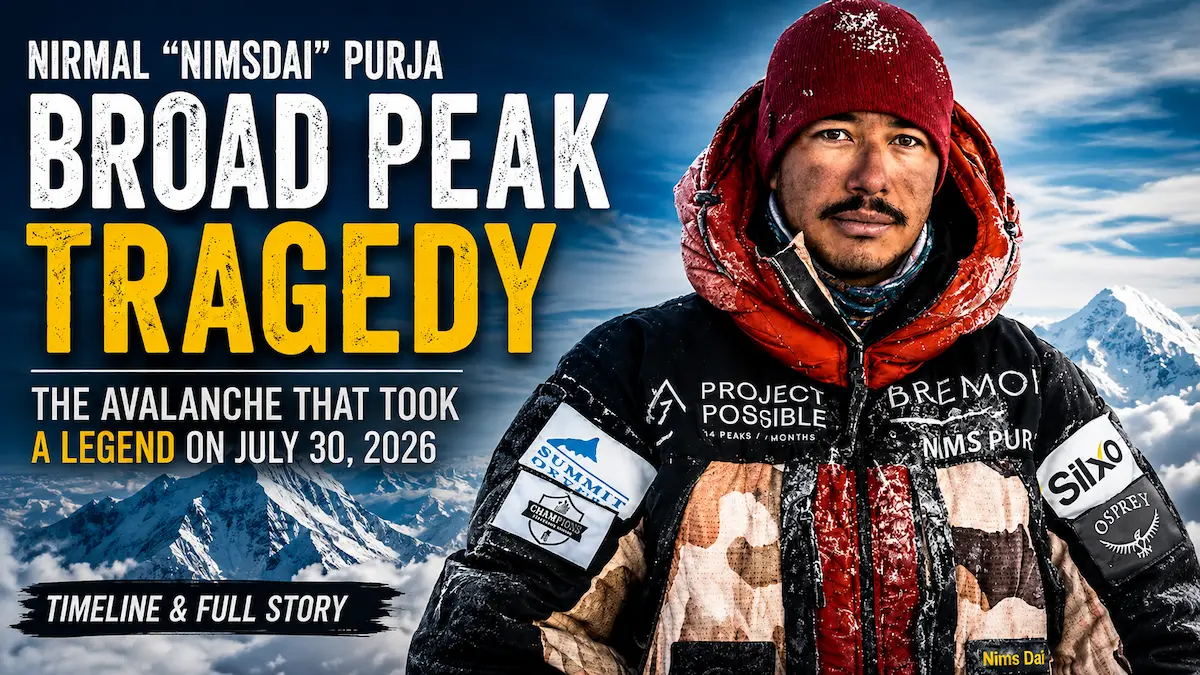
Quick Overview: Nirmal “Nimsdai” Purja, the legendary Nepalese mountaineer who inspired millions with his record-breaking Himalayan achievements, tragically lost his life in an avalanche on Broad Peak. The mountain that witnessed some of his greatest accomplishments became the place where his extraordinary journey came to an end. His passing is not only a loss for Nepal and the global climbing community but also a reminder of the immense risks faced by those who dedicate their lives to exploring the world’s highest peaks.
Nirmal “Nimsdai” Purja began his final Broad Peak expedition during the 2026 climbing season in Pakistan’s Karakoram Range. For Purja, Broad Peak was not an unfamiliar mountain. It was one of the fourteen 8,000-meter peaks he had already climbed during his historic Project Possible expedition in 2019. Returning to the mountain years later, he once again entered the extreme environment that had shaped much of his mountaineering career.
The expedition was filled with the same challenges that define every climb above 8,000 meters. Thin air, freezing temperatures, unpredictable weather, and unstable snow conditions create an environment where every decision can become a matter of life and death.
The tragedy unfolded on Thursday, July 30, 2026. During the climb on Broad Peak, a powerful avalanche struck the expedition team at high altitude. The avalanche swept through the climbing route and left several climbers missing. Nirmal Purja and other members of the expedition were caught in the disaster.
At such extreme altitude, an avalanche becomes one of the most dangerous events a climber can experience. Above 8,000 meters, the human body is already operating under severe stress. Low oxygen levels slow movement, reduce physical strength, and affect decision-making. When combined with a fast-moving avalanche, the chances of survival become extremely limited.
The expedition immediately changed from a climbing mission into a rescue operation.
July 30, 2026: The Avalanche Strikes Broad Peak
On Thursday, July 30, 2026, Nirmal Purja and his team were climbing on Broad Peak when the avalanche occurred.
The mountain had been experiencing difficult conditions, with unstable snow layers and changing weather patterns creating additional risks. Broad Peak is known for its long summit route, steep sections, and unpredictable conditions. Even highly experienced climbers must constantly evaluate whether the mountain is safe enough to continue.
The avalanche released suddenly, sending a large mass of snow and ice down the mountain slope. The force of an avalanche at high altitude is enormous. It can bury climbers under heavy snow, separate team members, destroy climbing equipment, and make communication extremely difficult.
After the avalanche stopped, several climbers were reported missing. The immediate priority was no longer reaching the summit. The focus shifted completely toward finding and helping those affected.
July 31, 2026: Rescue Teams Begin the Search
On Friday, July 31, 2026, rescue efforts began on Broad Peak.
The operation involved coordination between expedition members, local authorities, and experienced mountain rescue personnel. The main objective was to locate missing climbers and determine whether anyone had survived the avalanche.
However, rescuing climbers from Broad Peak presented enormous challenges.
The mountain’s remote location in the Karakoram Range meant that rescue resources were limited. The high altitude created additional dangers for rescuers, who had to work in the same harsh environment that had caused the accident.
Search teams faced several difficulties:
- Extremely low oxygen levels above 8,000 meters.
- Unstable snow conditions after the avalanche.
- Risk of additional avalanches.
- Freezing temperatures and strong winds.
- Difficult access to the accident area.
- Limited time available for survival searches.
Rescue teams used available methods, including ground searches, aerial observation, and communication with teams on the mountain. Every decision had to be carefully considered because rushing into an unstable avalanche zone could put more lives at risk.
The Recovery Operation
After the avalanche, Nirmal Purja and other climbers remained missing while search operations continued.
Recovering climbers from an avalanche above 8,000 meters is one of the most difficult tasks in mountaineering. Unlike lower-altitude rescue operations, where large teams and medical equipment can quickly reach accident locations, Himalayan rescues are limited by geography, weather, and altitude.
The rescue teams had to carefully move through dangerous terrain while searching areas affected by the avalanche. The mountain remained unstable, and every movement carried risk.
Weather conditions also affected the operation. Strong winds, snowfall, and poor visibility can stop helicopter support and slow ground searches. At these elevations, even experienced rescuers cannot work for long periods because the environment rapidly drains physical energy.
Despite these challenges, search teams continued their efforts to locate the missing climbers and provide confirmation to their families and the mountaineering community.
How Nirmal Purja Was Confirmed Dead
Following the avalanche, Nirmal Purja was listed among the missing climbers. Rescue teams continued searching the affected area while efforts focused on locating all members of the expedition.
After recovery operations reached the avalanche site, the bodies of the missing climbers were located. The identification process confirmed that Nirmal Purja and the other members of the expedition had died in the avalanche.
The confirmation of his death brought deep sadness throughout the climbing world.
For many people, Purja was not only a record-breaking mountaineer. He was a symbol of determination and possibility. His journey from a Gurkha soldier to one of the most recognized climbers in history inspired millions of people around the world.
His death was a reminder that even the strongest and most experienced climbers remain vulnerable when facing the power of the world’s highest mountains.
Why the Rescue Was So Difficult
The Broad Peak tragedy highlights why high-altitude rescue operations are among the most dangerous missions on Earth.
Extreme Altitude
Above 8,000 meters, the human body cannot function normally for long periods. Rescuers experience the same effects as climbers, including exhaustion, slower movement, and reduced concentration.
Avalanche Danger
After a major avalanche, the mountain may remain unstable. Rescue teams must search carefully because another avalanche can happen without warning.
Harsh Weather
The Karakoram is famous for rapidly changing weather. Strong winds, heavy snowfall, and low visibility can stop rescue operations immediately.
Remote Location
Broad Peak is located in a difficult-to-access region. Moving rescue teams, equipment, and medical support requires significant planning and time.
These challenges explain why even the most experienced rescue teams sometimes face situations where saving everyone is impossible.
The Final Chapter of Nirmal Purja’s Journey
Nirmal Purja’s final expedition ended in tragedy, but his influence on mountaineering will continue for many years.
His achievements changed the history of high-altitude climbing. Completing all fourteen 8,000-meter peaks in six months and six days showed the world what extraordinary preparation and determination could achieve.
However, his legacy is much bigger than his records.
He inspired people to challenge their own limits. He showed the importance of discipline, teamwork, and courage. He represented a generation of climbers who pushed boundaries while respecting the mountains they explored.
Broad Peak gave him one of his greatest achievements in 2019, and years later, it became the place where his remarkable journey came to an end on Thursday, July 30, 2026.
His story will remain a reminder that mountains offer incredible beauty and unforgettable experiences, but they also demand humility and respect. The greatest climbers are not remembered only for the summits they reach. They are remembered for the inspiration they leave behind.
In the world of extreme mountaineering, few names command as much respect as Nirmal “Nims” Purja. Known for redefining what is possible in high-altitude climbing, the former Gurkha and UK Special Boat Service (SBS) soldier has become one of the most recognizable figures in modern Himalayan expeditions. His record-breaking ascent of all fourteen 8,000-meter peaks in just over six months stunned the climbing community and transformed him into an international icon.
Yet the mountains do not recognize records, fame, or experience.
Among the many dangerous situations Purja has faced, the Broad Peak avalanche stands as a powerful reminder that even the world’s most accomplished climbers remain vulnerable to nature’s immense power. High above sea level, where oxygen is scarce and every decision carries life-or-death consequences, avalanches can erase carefully planned routes within seconds.
Broad Peak, one of Pakistan’s five 8,000-meter mountains, has earned a reputation for unpredictable weather, unstable snow conditions, and technically demanding terrain. Climbers attempting its summit must contend not only with altitude sickness and exhaustion but also with one of mountaineering’s greatest threats—avalanches.
The incident involving Nirmal Purja drew global attention because it highlighted far more than a dramatic survival story. It demonstrated exceptional leadership, rapid decision-making, and the responsibilities that experienced climbers often shoulder when lives are at stake.
This article explores the story behind the Broad Peak avalanche, the mountain itself, why avalanches occur so frequently in the Karakoram, and what climbers around the world can learn from one of the most dangerous environments on Earth.
Who Is Nirmal Purja?
Before understanding the significance of the Broad Peak incident, it is important to understand the man at its center.
Born in the Myagdi District of Nepal in 1983, Nirmal Purja grew up in a family connected to the Gurkhas. His childhood was far removed from the luxury often associated with elite sports. Instead, it was shaped by determination, discipline, and resilience.
He later joined the British Army’s Brigade of Gurkhas, where he developed exceptional physical endurance and mental toughness. His military career reached another extraordinary milestone when he became one of the very few Nepalese soldiers accepted into the UK Special Boat Service (SBS), one of the world’s most elite special forces units.
The military instilled skills that would later become invaluable in the mountains:
- Risk assessment
- Team leadership
- Crisis management
- Rapid decision-making
- Physical endurance under extreme stress
These qualities eventually became hallmarks of his mountaineering career.
From Soldier to Elite Mountaineer
Unlike many professional climbers who begin mountaineering in their teenage years, Purja entered the world of high-altitude climbing relatively late.
His progress, however, was astonishing.
Within only a few years he was climbing some of the world’s most difficult mountains with remarkable speed.
His achievements include:
- Everest
- Lhotse
- Makalu
- Annapurna
- K2
- Kangchenjunga
- Manaslu
- Dhaulagiri
- Nanga Parbat
- Broad Peak
- Gasherbrum I
- Gasherbrum II
- Cho Oyu
- Shishapangma
Completing all fourteen 8,000-meter peaks is already considered one of mountaineering’s greatest accomplishments.
Purja accomplished them in 6 months and 6 days, shattering the previous record of nearly eight years.
The feat became internationally famous through the Netflix documentary 14 Peaks: Nothing Is Impossible, introducing millions of viewers to his philosophy:
“Impossible is not a fact. It’s an opinion.”
However, behind these inspiring achievements lies a reality often overlooked by casual audiences: every expedition involves extraordinary risk.
Understanding Broad Peak
Standing at 8,051 meters (26,414 feet), Broad Peak is the world’s twelfth-highest mountain.
It is located in Pakistan’s Karakoram Range, only a few kilometers from K2.
Despite being overshadowed by its famous neighbor, Broad Peak is far from an easy climb.
Many experienced mountaineers consider it one of the most deceptive 8,000-meter peaks.
Why Is It Called Broad Peak?
The mountain received its English name because of its enormous summit ridge, which stretches for nearly 1.5 kilometers.
Unlike sharply pointed summits such as the Matterhorn, Broad Peak appears wide and expansive from a distance.
Its local Balti name is Falchan Kangri, meaning “Broad Peak.”
Geographic Challenges
Broad Peak rises directly above the Baltoro Glacier, one of the largest glaciers outside the polar regions.
This location creates unique weather patterns.
Cold air masses collide with moisture arriving from different directions, generating:
- Heavy snowfall
- Strong jet stream winds
- Rapid temperature changes
- Unstable snowpacks
These conditions significantly increase avalanche danger.
Why Broad Peak Is So Dangerous
Many climbers assume Broad Peak is easier than K2.
While technically less difficult in some sections, Broad Peak presents its own deadly challenges.
These include:
1. High Altitude
Above 8,000 meters lies the infamous Death Zone.
Here:
- Oxygen levels are approximately one-third of those at sea level.
- Human bodies begin deteriorating rapidly.
- Decision-making slows.
- Muscle recovery becomes almost impossible.
Even experienced climbers become physically and mentally vulnerable.
2. Long Summit Ridge
Unlike mountains with a clearly defined summit, Broad Peak’s lengthy ridge can be psychologically exhausting.
Many climbers mistakenly believe they have reached the top only to discover another rise ahead.
This often leads to:
- Delayed descents
- Increased fatigue
- Greater exposure to changing weather
3. Rapid Weather Changes
The Karakoram is notorious for unpredictable weather.
A clear morning can transform into:
- Whiteout conditions
- Hurricane-force winds
- Heavy snowfall
- Ice storms
These sudden changes have contributed to numerous climbing accidents.
4. Avalanche Terrain
Perhaps Broad Peak’s greatest danger is its avalanche-prone slopes.
Large snowfields accumulate throughout the climbing season.
When fresh snowfall combines with wind-loaded slopes or warming temperatures, entire snow slabs can release without warning.
This creates one of the mountain’s most unpredictable hazards.
Avalanches in the Karakoram
Unlike rockfalls, avalanches are often impossible to predict with complete accuracy.
Even when climbers carefully analyze weather forecasts and snow conditions, hidden weaknesses may exist beneath the surface.
Several factors contribute to avalanche formation.
Fresh Snowfall
Heavy snow adds weight to existing layers.
If the bond between layers is weak, the entire slope can collapse.
Wind Loading
Strong winds transport snow from one side of a mountain to another.
This creates dense slabs that may appear stable but are actually under immense stress.
Temperature Changes
Sunlight or warmer temperatures weaken snowpack bonds.
This often increases avalanche risk during afternoons.
Human Triggers
Sometimes the weight of a single climber is enough to trigger a slab avalanche.
Above 7,000 meters, these events can become catastrophic due to steep terrain and limited escape options.
Nirmal Purja’s Approach to Risk
One characteristic consistently separates Purja from many elite climbers.
He never portrays mountaineering as risk-free.
Instead, he emphasizes preparation over fearlessness.
His expeditions typically involve:
- Detailed weather forecasting
- Multiple contingency plans
- Strong communication systems
- Experienced Sherpa teams
- Efficient movement to reduce exposure time
- Continuous assessment of mountain conditions
This military-style planning has been credited with many successful expeditions.
However, even perfect planning cannot eliminate natural hazards.
The mountains always retain the final say.
The Broad Peak Avalanche Incident
During a climbing season on Broad Peak, dangerous snow conditions developed following periods of unstable weather. Fresh snowfall, combined with wind transport and steep terrain, increased the likelihood of avalanche activity on sections of the mountain frequently used by climbers moving between the higher camps and the summit route.
As teams progressed through these exposed areas, an avalanche swept across part of the route. In high-altitude environments like Broad Peak, such events unfold in moments. Climbers have little opportunity to react, and the consequences can include burial, traumatic injuries, damaged equipment, or the destruction of fixed ropes that are essential for safe movement.
Accounts from the expedition indicate that Purja and members of his team responded immediately to the emergency. Rather than focusing solely on their own summit objectives, priority shifted toward evaluating the safety of the remaining route, accounting for climbers, and assisting those affected. This type of response reflects a broader principle in expedition mountaineering: when lives are in danger, rescue efforts take precedence over reaching the summit.
The incident also underscored how quickly conditions on Broad Peak can change. A slope that appears stable in the morning can become hazardous after additional snowfall, wind loading, or subtle changes within the snowpack. Even highly experienced climbers equipped with modern forecasting tools cannot remove every element of uncertainty.
For Purja, the avalanche reinforced a message he has repeated throughout his career: success in the mountains is measured not only by summits reached, but by everyone returning home safely. Leadership at extreme altitude often means making difficult decisions, including delaying or abandoning climbing objectives when the risks become unacceptable.
Why the Incident Resonated Worldwide
News of the Broad Peak avalanche attracted significant attention because it illustrated the realities behind high-profile Himalayan expeditions. Public attention often centers on records, speed ascents, and summit photographs, yet incidents like this reveal the constant balance between ambition and survival.
Experienced mountaineers noted several important takeaways:
- No climber is immune to objective hazards. Skill and preparation reduce risk but cannot eliminate it.
- Decision-making under pressure is critical. Calm leadership can make a substantial difference during emergencies.
- Teamwork is essential. High-altitude climbing depends on cooperation among climbers, guides, and support staff, particularly when unexpected events occur.
- Turning back can be the right decision. Successful expeditions prioritize life over achievement.
The Broad Peak avalanche serves as a reminder that every ascent of an 8,000-meter peak involves uncertainty. Behind each successful summit lies extensive preparation, disciplined judgment, and respect for conditions that can change without warning.
The Broad Peak Avalanche That Captured Global Attention
If you’ve followed Himalayan climbing over the past few years, you’ve probably noticed that avalanches have become one of the biggest concerns for expedition teams. Unlike storms, which can often be tracked days in advance, avalanches are unpredictable. A slope that appears perfectly stable in the morning can become deadly just a few hours later after fresh snowfall, rising temperatures, or strong winds reshape the mountain.
Broad Peak is no stranger to these conditions. During the climbing season, expedition teams carefully monitor weather forecasts, snow accumulation, and route conditions before moving between camps or making a summit push. Despite all this planning, the mountain can still surprise even the most experienced climbers.
During one expedition on Broad Peak, dangerous snow conditions developed after a period of unstable weather. Fresh snow had settled across steep sections of the route, while strong winds packed that snow into dense layers known as wind slabs. To someone looking up from base camp, everything might have appeared calm. For experienced climbers, however, those conditions raised serious concerns because wind-loaded slopes are among the most common triggers for avalanches.
As climbers moved through one of these exposed sections, part of the snowpack released. Within seconds, snow and ice rushed down the mountainside, sweeping across the climbing route. At altitudes above 7,000 meters, there is very little time to react. The thin air slows movement, heavy equipment limits mobility, and the terrain offers few safe places to escape.
For everyone on the mountain, the situation changed instantly. The goal was no longer reaching the summit. Survival became the only priority.
How Nirmal Purja Responded Under Pressure
One reason Nirmal Purja is respected throughout the mountaineering community is that he has consistently shown that leadership matters more than personal achievement. While many people know him for breaking climbing records, fellow climbers often speak about his willingness to help others, even when it means sacrificing his own goals.
Following the avalanche, Purja and his team shifted their attention from climbing to assessing the safety of everyone on the route. In high-altitude environments, every decision has consequences. Before any rescue attempt can begin, climbers must determine whether the slope remains unstable. Entering an avalanche zone too quickly can place rescuers in the same danger as the people they are trying to help.
This is where experience becomes invaluable.
Instead of reacting emotionally, experienced expedition leaders follow a process. They assess the conditions, account for team members, communicate with nearby climbers, and identify the safest course of action. Military discipline, developed during Purja’s years with the Gurkhas and the UK Special Boat Service, has shaped the way he approaches these situations. Remaining calm under extreme pressure is not simply a personal strength. It is a skill that can save lives.
The incident reinforced a lesson Purja has shared throughout his career. Reaching the summit is optional. Returning home safely is not.
Why Avalanches Are So Difficult to Predict
If you’re wondering why modern technology cannot completely prevent avalanche accidents, the answer lies in the complexity of snow.
Snow is not a single solid layer. Every snowfall creates a new layer with different characteristics. Some layers bond tightly together, while others remain weak and unstable. Wind can compress snow into dense slabs, while sunlight and temperature changes gradually weaken the structure beneath them.
Imagine stacking several sheets of paper on top of a layer of marbles. Everything might look stable from above, but a small amount of pressure can cause the entire stack to slide. Avalanche-prone slopes behave in a similar way.
Experienced mountaineers study several warning signs before moving across dangerous terrain, including:
- Recent heavy snowfall.
- Strong winds that create snowdrifts.
- Cracking sounds beneath the snow.
- Sudden increases in temperature.
- Evidence of previous avalanches nearby.
Even when none of these warning signs are obvious, hidden weaknesses can still exist beneath the surface. That uncertainty is what makes avalanche terrain so dangerous.
Life in the Death Zone
It’s easy to underestimate how much altitude affects the human body until you understand what happens above 8,000 meters.
At sea level, every breath provides your muscles and brain with the oxygen needed to function normally. On Broad Peak, the atmosphere contains only a fraction of that oxygen. As a result, every movement becomes slower, and every decision requires more effort.
Simple tasks such as adjusting climbing equipment, drinking water, or putting on a pair of gloves become surprisingly exhausting.
Your body also begins consuming its own muscle tissue because it cannot recover properly in such an extreme environment. Sleep becomes difficult, appetite disappears, and dehydration develops quickly despite the freezing temperatures.
Now imagine facing an avalanche while your body is already operating under these conditions.
This is why high-altitude emergencies are unlike rescues anywhere else in the world. Helicopters often cannot reach these elevations, medical assistance is limited, and climbers must rely heavily on one another.
Leadership Means More Than Reaching the Summit
One of the biggest misconceptions about mountaineering is that success is measured only by standing on the highest point.
If you’ve watched documentaries or followed Himalayan expeditions, you’ve probably noticed that experienced climbers celebrate something even more important than summits.
Everyone returning safely.
Purja has repeatedly emphasized that no mountain is worth a human life. That philosophy has earned him respect far beyond the climbing community.
During dangerous situations, strong leaders make difficult decisions that others may not immediately understand. Turning around just a few hundred meters below the summit can feel heartbreaking after weeks of preparation. However, experienced climbers know the summit is only halfway through the journey.
Many accidents happen during the descent because exhausted climbers continue pushing themselves after achieving their goal.
Leadership, therefore, is not about taking the greatest risks.
It is about knowing when the risks have become unacceptable.
Lessons You Can Learn from the Broad Peak Avalanche
Even if you never plan to climb an 8,000-meter mountain, the events on Broad Peak offer valuable lessons that apply far beyond mountaineering.
The first lesson is that preparation matters. Success rarely depends on courage alone. Behind every successful expedition are months of planning, physical training, route research, weather analysis, and teamwork.
The second lesson is that experience should never lead to overconfidence. Nature does not care how many mountains you’ve climbed or how many records you’ve broken. Every expedition begins with the same responsibility to respect changing conditions.
Another important lesson is the value of teamwork. High-altitude climbing is never a solo achievement, even when only one person stands on the summit. Sherpas, guides, weather forecasters, support staff, and fellow climbers all contribute to the safety and success of an expedition.
Finally, the Broad Peak avalanche reminds us that resilience is not about pretending danger doesn’t exist. Real resilience comes from staying calm, making thoughtful decisions, and adapting when circumstances suddenly change.
The Lasting Legacy of the Incident
The Broad Peak avalanche is remembered not because it produced another climbing record but because it highlighted the realities of Himalayan mountaineering. It showed that even elite climbers face situations they cannot fully control. It also reinforced the importance of preparation, leadership, and responsible decision-making in one of the harshest environments on Earth.
For Nirmal Purja, the incident became another chapter in a career defined not only by extraordinary achievements but also by a commitment to protecting others whenever possible. His reputation extends beyond speed records because he consistently demonstrates that great mountaineering is about more than reaching the summit. It is about making choices that give everyone the best chance of returning home safely.
As more people become interested in climbing the world’s highest mountains, stories like this serve as an important reminder that the Himalayas and the Karakoram should never be underestimated. Their beauty attracts adventurers from every corner of the world, but that beauty exists alongside immense power and unpredictable danger.
If there’s one message you should take away from the Broad Peak avalanche, it’s this: the greatest climbers are not those who conquer mountains. They are the ones who respect them.
FAQs
What happened during the Broad Peak avalanche involving Nirmal Purja?
The Broad Peak avalanche occurred during an expedition when unstable snow conditions created a dangerous situation on the mountain. Heavy snowfall, wind-loaded slopes, and changing weather increased avalanche risk. The event highlighted how quickly conditions can change above 8,000 meters and showed the importance of quick decision-making, teamwork, and risk assessment in extreme environments.
Why is Broad Peak considered a dangerous mountain?
Broad Peak is considered dangerous because of its extreme altitude, unpredictable weather, avalanche-prone slopes, and challenging terrain. Although it is sometimes viewed as less technical than nearby K2, the mountain presents serious risks due to unstable snow conditions, long summit routes, and the physical effects of climbing in the death zone.
How high is Broad Peak?
Broad Peak rises to an elevation of 8,051 meters (26,414 feet) above sea level. It is the twelfth-highest mountain in the world and is located in Pakistan’s Karakoram Range near K2.
What causes avalanches on Broad Peak?
Avalanches on Broad Peak can be caused by several factors, including fresh snowfall, strong winds, temperature changes, and weak layers within the snowpack. Wind can create unstable snow slabs, while warming temperatures can weaken the connection between different snow layers, increasing the possibility of a sudden collapse.
Has Nirmal Purja climbed Broad Peak?
Yes, Nirmal Purja successfully climbed Broad Peak as part of his Project Possible challenge to complete all fourteen 8,000-meter peaks. The climb was one of the many achievements that contributed to his record-breaking Himalayan career.
What makes Nirmal Purja different from other climbers?
Nirmal Purja is known not only for his speed and physical ability but also for his leadership style. His military background helped him develop discipline, decision-making skills, and the ability to remain calm during dangerous situations. Many climbers respect him for focusing on teamwork and safety rather than only personal achievement.
What is the Death Zone in mountaineering?
The Death Zone refers to areas above approximately 8,000 meters where the human body cannot properly adapt to the lack of oxygen for long periods. At this altitude, climbers experience extreme fatigue, slower thinking, reduced physical performance, and increased risk of serious health problems.
Can modern technology prevent mountain avalanches?
Modern technology can help predict and reduce avalanche risks, but it cannot completely prevent them. Weather forecasts, satellite data, snow analysis, and climbing equipment help teams make better decisions, but mountain conditions can change rapidly and remain unpredictable.
What can climbers learn from the Broad Peak avalanche?
The Broad Peak avalanche teaches climbers the importance of preparation, patience, teamwork, and respecting mountain conditions. The biggest lesson is that reaching the summit should never be more important than returning safely. Good judgment and knowing when to stop are essential qualities of successful mountaineers.
Why are avalanches more dangerous above 8,000 meters?
Avalanches become especially dangerous above 8,000 meters because climbers are already physically weakened by extreme altitude. Low oxygen levels reduce reaction speed, rescue options are limited, and surviving an avalanche is much more difficult when climbers are exhausted and carrying heavy equipment.
What is Nirmal Purja’s climbing philosophy?
Nirmal Purja believes that preparation, teamwork, and determination are key to achieving difficult goals. However, he also emphasizes respecting the mountain and understanding that survival is more important than any record or summit achievement.
How many 8,000-meter peaks did Nirmal Purja climb?
Nirmal Purja climbed all fourteen of the world’s 8,000-meter mountains. He completed this challenge in six months and six days, setting a new world record for the fastest completion of all fourteen peaks.
Is Broad Peak harder than Everest?
Broad Peak and Everest present different challenges. Everest is higher and has a larger number of climbers attempting it each year, but Broad Peak can be more unpredictable because of its remote location, avalanche risks, unstable weather, and demanding Karakoram conditions.
What is the biggest lesson from Nirmal Purja’s Broad Peak experience?
The biggest lesson is that true mountaineering success is not only about reaching the top. It is about preparation, leadership, decision-making, and bringing people back safely. The mountain always deserves respect, no matter how experienced the climber may be.
