


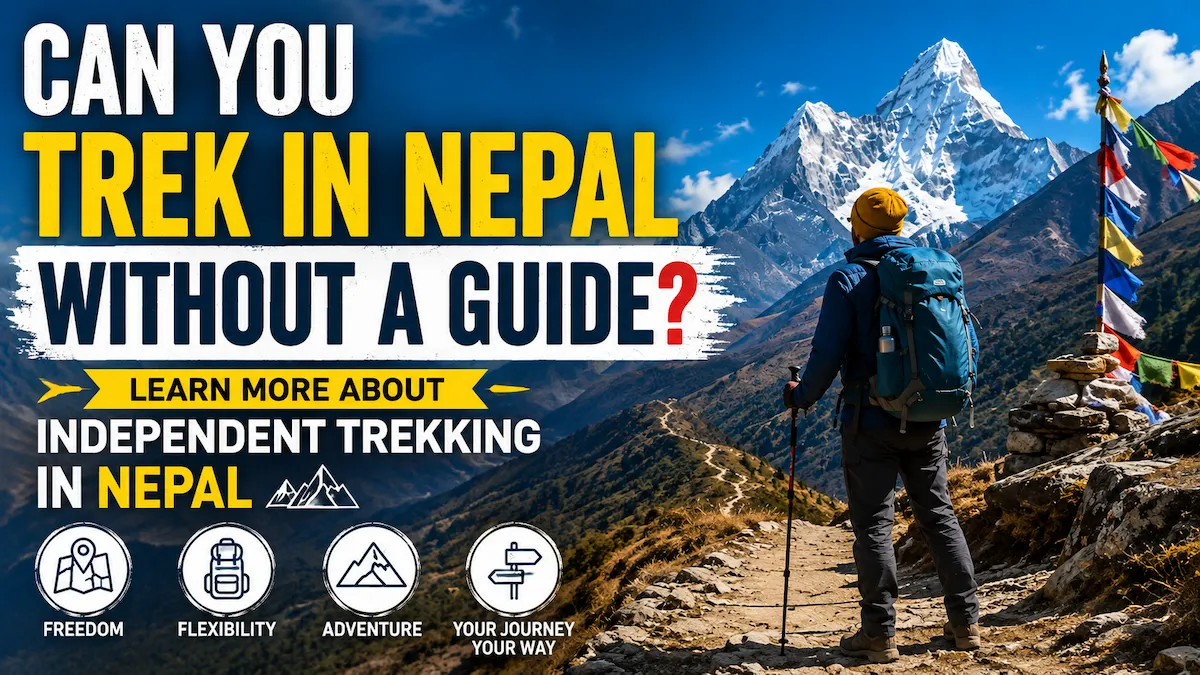
Nepal is one of the world’s most famous trekking destinations, attracting adventurers from across the globe to the Himalayas. From the legendary Everest Base Camp and Annapurna Circuit to the quieter trails of Langtang, Manaslu, Mustang and Dolpo, Nepal offers trekking experiences for almost every level of hiker.
But one question comes up repeatedly among independent travelers:
Can you trek in Nepal without a guide? The short answer is: sometimes, but not on many of Nepal’s major trekking routes.
Nepal’s trekking regulations have changed significantly in recent years. The Nepal Tourism Board states that licensed trekking guides and trekking-agency-issued TIMS cards are mandatory on a large number of trekking routes. These include popular routes in the Everest, Annapurna, Langtang, Manaslu, Kanchenjunga, Makalu, Mustang, Dolpo and other regions.
This means that the traditional idea of simply arriving in Nepal, buying a permit and walking into the mountains alone is no longer possible for many of the country’s best-known trekking routes.
However, the situation is more nuanced than simply saying “guides are mandatory everywhere.” Whether you can trek independently depends on your chosen route, the applicable regulations, the permits required and the current rules in effect when you travel.
This guide explains everything you need to know about trekking in Nepal without a guide, why hiring a guide can be valuable, what guides actually do, how much they cost, and how to choose the right trekking professional.
Can You Trek in Nepal Without a Guide?
Yes, independent trekking may still be possible on some routes, but you cannot assume that every trekking route allows you to travel without a guide.
The Nepal Tourism Board currently identifies numerous trekking routes where trekkers must be accompanied by a licensed trekking guide and obtain a TIMS card through a registered trekking agency.
The list includes many of Nepal’s most popular trekking destinations.
Major routes where a guide is required
According to the Nepal Tourism Board’s current TIMS guidance, the mandatory-guide list includes routes such as:
- Everest Base Camp
- Gokyo Valley
- Everest Three Passes
- Everest View Trek
- Mera Peak
- Annapurna Circuit
- Annapurna Base Camp
- Mardi Himal
- Khopra Trek
- Manaslu Circuit
- Manaslu–Tsum Valley
- Tsum Valley
- Langtang Valley
- Langtang–Gosaikund
- Tamang Heritage Trek
- Upper Mustang
- Upper and Lower Dolpo routes
- Kanchenjunga Base Camp
- Makalu Base Camp
- Rolwaling
- Several restricted-area and high-pass treks
The official list is considerably longer and includes specific routes in protected and restricted regions.
Therefore, the first step should always be checking the current rules for your exact trekking route rather than assuming that independent trekking is permitted.
Why Do You Need a Guide for Trekking in Nepal?
The requirement for a guide is not simply about having someone walk in front of you and show you the trail.
A professional trekking guide provides a combination of safety management, navigation, logistics, cultural interpretation and emergency support.
The Himalayas are beautiful, but they are also a demanding environment. Weather can change quickly, trails can become difficult to follow, altitude can affect the body, and seemingly small problems can become serious when you are several hours or days away from a road.
Here are the main reasons trekkers choose—or are required—to travel with a guide.
1. Safety and Risk Management
One of the most important responsibilities of a trekking guide is keeping the group safe. A guide with appropriate experience can recognize potential hazards before they become serious problems.
These can include:
- Sudden weather changes
- Snowfall
- Landslides
- Rockfall
- Difficult river crossings
- Icy trails
- High winds
- Trail closures
- Altitude-related problems
- Exhaustion and dehydration
- Injuries
- Navigation problems
In the Himalayas, conditions can change dramatically within a few hours. A route that was comfortable in the morning can become difficult because of snow, rain, wind or poor visibility.
An experienced guide can evaluate the situation and decide whether the group should continue, slow down, change the itinerary or stop for the day.
2. Recognizing Acute Mountain Sickness (AMS)
Altitude is one of the biggest dangers for trekkers in Nepal. Acute Mountain Sickness, commonly known as AMS, can affect people who ascend too quickly to high elevations.
Early symptoms can include:
- Headache
- Nausea
- Loss of appetite
- Dizziness
- Fatigue
- Difficulty sleeping
- Shortness of breath
More serious altitude illnesses can become life-threatening.
A good guide does not simply ask, “Can you walk?”
They pay attention to changes in a trekker’s behavior, walking pace, appetite, coordination and overall condition.
If someone is showing signs of serious altitude illness, the correct response may be to stop ascending and descend to a lower elevation rather than pushing toward the next destination.
This is particularly important on high-altitude treks such as Everest Base Camp, Three Passes, Manaslu, Annapurna Circuit and other routes involving high passes.
3. Emergency Response and Evacuation
An accident in Kathmandu is very different from an accident several days into a Himalayan trek. If a trekker becomes seriously ill or injured in a remote mountain village, they may need assistance arranging:
- Local transportation
- Horse or mule assistance
- Porters
- Helicopter evacuation
- Medical treatment
- Communication with trekking agencies
- Insurance documentation
A guide can coordinate these processes while the trekker concentrates on their health.
This does not mean that every guide can personally perform an evacuation. Rather, an experienced guide understands the local system and can coordinate with the appropriate people and agencies.
Trekkers should still carry travel insurance that specifically covers trekking at the altitude and activity level of their itinerary.
4. Navigation and Route Planning
Many popular trekking routes have well-established trails, but “well established” does not mean impossible to get lost on. Mountain trails can branch, disappear under snow or become confusing around villages, forests and river crossings.
A guide can help with:
- Daily route planning
- Trail selection
- Estimating walking times
- Identifying difficult sections
- Choosing appropriate rest stops
- Adjusting the itinerary
- Finding alternative routes
- Managing pace
This becomes particularly important on less-developed or high-pass routes.
A guide’s value is often most obvious when conditions are not ideal.
5. Managing the Trekking Schedule
A common mistake among inexperienced trekkers is planning a trek purely according to distance. Walking 15 kilometers in a low-altitude city is not comparable to walking the same distance at 4,000 or 5,000 meters.
A guide understands that:
Altitude + terrain + weather + acclimatization + individual fitness = realistic trekking time.
Instead of focusing only on kilometers, a guide can structure the itinerary around safe acclimatization and manageable daily walking.
This can make the difference between enjoying a trek and spending several days exhausted.
6. Accommodation and Teahouse Logistics
Most popular trekking routes in Nepal have teahouses and lodges. During peak trekking seasons, however, popular villages can become busy. A guide can help arrange accommodation and communicate with lodge owners.
They may also know:
- Which teahouses are reliable
- Where food is available
- Which villages have better facilities
- Where hot showers are available
- Where charging facilities exist
- Where Wi-Fi or mobile connectivity may work
- Which stops make sense for acclimatization
This local knowledge can be particularly useful when trekking during busy periods.
7. Permits and TIMS
Trekking in Nepal involves more than simply arriving at a trailhead and walking. Depending on the route, you may need:
- TIMS
- National park entry permits
- Conservation area permits
- Restricted-area trekking permits
- Local permits
- Other route-specific documentation
The Nepal Tourism Board currently states that trekkers on designated routes must obtain a trekking-agency-issued TIMS card and travel with a licensed guide. The current TIMS charges listed by the Nepal Tourism Board are NPR 1,000 for SAARC-country applicants and NPR 2,000 for other applicants.
Permit rules can change, so trekkers should verify the requirements for their exact route before departure.
A registered trekking agency can handle much of this paperwork.
8. Cultural Interpretation
A trekking guide is also a bridge between visitors and local communities. Nepal is not simply a landscape of mountains. The trekking regions are home to diverse ethnic communities, languages, religions, traditions and histories.
Depending on the region, a guide may explain:
- Buddhist traditions
- Hindu traditions
- Sherpa culture
- Gurung communities
- Tamang communities
- Thakali culture
- Local festivals
- Monasteries
- Prayer flags
- Mani walls
- Prayer wheels
- Traditional architecture
- Local food
- Mountain legends
Without a guide, a trekker may see a monastery or religious monument.
With a knowledgeable local guide, they may understand why it matters.
That can transform a trek from a physical journey into a cultural experience.
9. Language and Communication
English is widely used in Nepal’s tourism industry, but communication becomes more complicated in remote areas. A local guide can communicate with:
- Teahouse owners
- Porters
- Drivers
- Local authorities
- Health posts
- Villagers
- Rescue providers
- Other trekking staff
This can be especially useful when something goes wrong.
Even simple situations—such as explaining dietary requirements, finding a missing item or arranging transportation—can become easier with a local person who understands the language and local customs.
10. Responsible and Sustainable Trekking
A professional guide can also help trekkers minimize their environmental and social impact. Responsible trekking includes:
- Avoiding unnecessary plastic waste
- Respecting local customs
- Staying on designated trails
- Not disturbing wildlife
- Disposing of waste correctly
- Respecting religious sites
- Supporting locally owned businesses
- Treating porters fairly
- Avoiding excessive loads
Guides can help visitors understand that responsible trekking is not just about leaving no litter behind.
It is also about leaving communities, workers and the environment with respect.
What Does a Trekking Guide Actually Do?
Many first-time trekkers imagine a guide as someone who simply knows the way.
In reality, a professional guide may have many responsibilities.
Before the trek
A guide or trekking agency may help with:
- Route planning
- Permit preparation
- TIMS processing
- Accommodation planning
- Transportation
- Gear recommendations
- Weather considerations
- Acclimatization planning
- Porter arrangements
- Emergency planning
During the trek
The guide may be responsible for:
- Navigation
- Group pacing
- Safety monitoring
- Altitude monitoring
- Accommodation coordination
- Meal coordination
- Communication
- Route adjustments
- Emergency response
- Cultural interpretation
At the end of the trek
The guide may also help with:
- Transportation
- Final logistics
- Staff payments
- Equipment returns
- Feedback
- Tipping arrangements
So when you pay for a guide, you are not simply paying someone to walk beside you.
You are paying for experience, local knowledge, risk management and logistical support.
How Much Does a Trekking Guide Cost in Nepal?
Guide prices vary according to the route, season, guide experience, trek duration, group size and whether you hire through an agency.
Current 2026 market estimates commonly place a licensed trekking guide at approximately:
USD $25–$50 per day
Some current trekking-industry estimates place standard guide rates around $25–$40 per day, while more experienced or specialized guides can cost around $30–$50 or more per day.
For example:
| Trek Length | Approximate Guide Cost |
|---|---|
| 5 days | $125–$250 |
| 7 days | $175–$350 |
| 10 days | $250–$500 |
| 12 days | $300–$600 |
| 14 days | $350–$700 |
| 18 days | $450–$900 |
These are guide-fee estimates only and should not be interpreted as the total cost of a Nepal trek.
Always confirm what the daily rate includes.
Does the Guide’s Fee Include Food and Accommodation?
This is one of the most important questions to ask before booking. Different agencies structure their prices differently.
A guide’s quoted daily rate may or may not include:
- Guide accommodation
- Guide meals
- Transportation
- Insurance
- Equipment
- Permits
- Guide wages
- Agency service charges
Some packages include these costs in the overall trek price, while an independently hired guide may have certain expenses added separately.
Never assume that “guide fee” means everything is included.
Ask for a written cost breakdown before you begin the trek.
How Much Does a Porter Cost in Nepal?
A porter is different from a trekking guide. A guide’s primary responsibility is leadership, navigation, safety and logistics, while a porter primarily carries trekking equipment and luggage.
Current market estimates commonly put porter rates around:
USD $18–$30 per day
Some 2026 trekking-industry estimates place porter rates at approximately $18–$28 per day, depending on the route and circumstances.
A porter can be particularly useful for trekkers who want to walk independently of carrying a heavy backpack.
However, responsible trekking also means considering the welfare of porters.
Guide vs. Porter: What Is the Difference?
| Trekking Guide | Porter |
|---|---|
| Leads the trek | Carries luggage |
| Navigates the route | Primarily provides carrying support |
| Monitors group safety | Helps with physical load |
| Helps with logistics | May help with basic trail logistics |
| Provides cultural interpretation | Usually has a more limited guiding role |
| Assists during emergencies | Can provide valuable practical assistance |
| Usually has trekking-guide training | May have porter-specific experience |
Some companies also offer porter-guides, who combine carrying assistance with basic guiding responsibilities.
However, trekkers should not assume that a porter-guide is equivalent to a fully licensed trekking guide, particularly when regulations require a licensed guide.
How Much Does a Full Guided Trek in Nepal Cost?
The total cost of trekking in Nepal depends heavily on the route.
A basic trek can involve:
- Guide
- Porter
- Accommodation
- Food
- Transportation
- TIMS
- National park/conservation permits
- Restricted-area permits where applicable
- Travel insurance
- Flights
- Equipment
- Tips
For a guided trek, the daily budget can therefore be considerably higher than the simple guide fee.
A useful way to think about the budget is:
Total Trek Cost = Guide + Porter + Food + Accommodation + Permits + Transportation + Insurance + Personal Expenses
For example, a 10-day trek might have a guide cost of roughly $250–$500, before adding the other expenses.
A 14-day trek could involve approximately $350–$700 for the guide alone, depending on the guide and arrangement.
Current market estimates also commonly place food and accommodation for independent trekkers in the broad range of approximately $25–$40 per person per day, although costs vary substantially by route and altitude.
Is Trekking Without a Guide Cheaper?
At first glance, trekking without a guide sounds much cheaper.
You might think:
“Why pay $30–$50 every day when I can follow the trail myself?”
That logic can make sense on a genuinely independent route.
However, on routes where a guide is mandatory, you cannot simply eliminate the guide cost.
There are also other costs to consider.
Independent trekking can involve:
- More responsibility for navigation
- More responsibility for accommodation
- Permit research
- Transportation planning
- Emergency planning
- Weather monitoring
- Route research
- Communication difficulties
- Higher risk of making expensive mistakes
A guided trek therefore isn’t necessarily about spending money for convenience.
In many situations, you are paying to reduce uncertainty.
When Is Trekking Without a Guide More Reasonable?
If a route legally permits independent trekking, going without a guide may appeal to experienced hikers.
Independent trekking can be suitable for someone who:
- Has significant hiking experience
- Understands altitude risks
- Can navigate confidently
- Can read maps and GPS
- Is comfortable traveling independently
- Understands local customs
- Has appropriate insurance
- Has researched the route carefully
- Has a realistic itinerary
- Knows how to respond to changing weather
- Has emergency communication options
But even experienced hikers should understand that technical hiking ability does not automatically equal Himalayan trekking experience.
Walking at altitude is different from walking at sea level.
Who Should Definitely Consider Hiring a Guide?
A guide is especially valuable for:
First-time Himalayan trekkers
If this is your first experience above 3,000–4,000 meters, having someone experienced can provide significant peace of mind.
Solo travelers
Solo trekking can be rewarding, but a guide provides an additional layer of support.
High-altitude trekkers
Routes involving high passes or prolonged time above 4,000 meters require more careful planning.
Trekkers attempting challenging routes
Three Passes, Manaslu, Dhaulagiri, Dolpo, Kanchenjunga and other demanding routes can involve difficult terrain and more complex logistics.
People traveling during unpredictable weather
Shoulder-season conditions can change quickly.
Travelers unfamiliar with Nepal
A local guide can remove much of the logistical complexity.
How to Choose the Right Trekking Guide
Hiring a guide is not simply about finding the cheapest person available.
The cheapest guide may not necessarily be the best guide for your route.
Ask the following questions before hiring.
1. Are You Licensed?
If your route requires a licensed trekking guide, verify that the person meets the applicable requirements.
You should also confirm that the agency handling your trek is properly registered.
2. How Much Experience Do You Have on This Route?
A guide may have 10 years of experience in Nepal but relatively little experience on the particular route you are planning.
Ask:
“How many times have you completed this trek?”
This is often more useful than simply asking how many years they have worked as a guide.
3. What Is Your High-Altitude Experience?
For high-altitude treks, ask specifically about experience at elevation.
A guide who frequently works on high mountain routes may be better prepared to recognize altitude-related problems.
4. What Happens If I Get Sick?
This is one of the most important questions.
Ask:
- What is the emergency procedure?
- Who contacts the rescue company?
- How is evacuation arranged?
- What happens if I cannot continue?
- Does the agency assist with insurance claims?
A professional guide should be able to explain the process clearly.
5. What Is Included in the Price?
Get a detailed answer about:
- Guide wages
- Guide meals
- Guide accommodation
- Transportation
- Permits
- TIMS
- Insurance
- Porter costs
- Agency fees
- Taxes
- Tips
Written quotations are preferable.
Ethical Trekking: Treat Guides and Porters Fairly
Guides and porters are an essential part of Nepal’s trekking industry.
However, travelers should remember that a low price is not always a good price.
A porter may carry a substantial load for many hours at high altitude.
Responsible trekkers should ask:
- How much weight will the porter carry?
- Does the porter have appropriate clothing?
- Does the porter have suitable footwear?
- Does the porter receive proper accommodation?
- Is the porter insured?
- Are meals provided?
- Is there an emergency plan?
- Are wages clearly defined?
Do not judge a trekking company solely by how cheaply it can provide a guide or porter.
Consider how that price affects the people doing the work.
Tipping Your Trekking Guide and Porter
Tipping is common in Nepal’s trekking industry, particularly when guides and porters have provided good service.
The exact amount varies according to:
- Trek length
- Group size
- Service quality
- Difficulty of the trek
- Guide responsibilities
- Porter workload
- Personal budget
Rather than treating a tip as an automatic fee, consider it recognition for good service.
It is also a good idea to ask your agency about its tipping practices before beginning the trek so that expectations are clear.
Real-World Example: Why a Guide Can Matter
Imagine a group trekking toward a high mountain pass.
- The weather forecast looked good in the morning, and the group begins walking.
- Several hours later, clouds begin to build.
- Visibility drops.
- The trail becomes covered by snow.
- One member of the group develops a severe headache and begins walking slowly.
An inexperienced trekker might think:
“We are only a few hours from the pass. We should keep going.”
An experienced guide may make a very different decision.
They may recognize that:
- The weather is deteriorating
- Visibility is becoming dangerous
- The trekker’s symptoms could be altitude-related
- Continuing upward could increase the risk
- Descending or stopping is safer
The guide’s most valuable decision may therefore be knowing when not to continue.
That is one of the biggest differences between simply knowing a trail and understanding mountain risk.
Guides as Cultural Ambassadors
One of the most overlooked benefits of hiring a guide is the cultural experience.
Imagine walking through a Himalayan village and seeing a Buddhist monastery.
Without local knowledge, you might simply photograph it and continue walking.
A guide may explain:
- Why the monastery was built
- What the prayer wheels represent
- Why prayer flags are placed in certain locations
- How local communities depend on the mountains
- Which festivals are celebrated
- How tourism has changed the village
- Why visitors should behave respectfully
The mountain landscape becomes more meaningful when you understand the people who live there.
Can You Trek Nepal Completely Independently?
For some routes, potentially yes.
For many of Nepal’s most popular and regulated routes, no.
The important distinction is between:
“Can I physically walk the trail alone?”
and
“Am I legally and administratively allowed to trek that route without a guide?”
Those are two completely different questions.
You may have the physical ability to walk a trail independently while still being required to travel with a licensed guide because of current trekking regulations.
The Nepal Tourism Board specifically advises trekkers to determine whether their chosen route requires a guide and TIMS before starting the trek.
What About Everest Base Camp?
Everest Base Camp is one of the most frequently searched routes by independent travelers.
However, the Nepal Tourism Board’s current list includes Everest Base Camp Trek among routes where trekkers must be accompanied by a licensed trekking guide and carry a trekking-agency-issued TIMS card.
The same list includes several other Everest-region routes, including:
- Gokyo
- Chho La
- Renjo La
- Three Passes
- Everest View
- Mera Peak
- Amphu Labtsha Pass
Therefore, travelers planning an Everest-region trek should not rely on old blog posts claiming that the route can simply be done independently.
What About Annapurna?
The Annapurna region is another area where regulations matter.
The current Nepal Tourism Board list includes:
- Annapurna Circuit
- Nar Phu Annapurna Circuit
- Mesokanto/Tilicho Pass
- Poon Hill–ABC
- Khopra
- Mardi Himal
- Sikleh Tara Hill
as routes covered by the current guide/TIMS requirement.
This is particularly important because older trekking guides and travel forums may contain information from before the current regulations were implemented.
What About Manaslu?
Manaslu is not a route where trekkers should assume they can travel independently.
The current Nepal Tourism Board guidance includes:
- Manaslu Circuit
- Manaslu–Tsum Valley
- Tsum Valley
among the routes requiring a licensed guide and agency-issued TIMS under the current provisions.
Manaslu also involves more complicated permit arrangements, making professional assistance particularly valuable.
The Advantages of Hiring a Guide
A guide provides several advantages beyond simply meeting regulatory requirements.
Safety
Someone experienced is monitoring the environment and your condition.
Navigation
You have a person who knows the route.
Logistics
Accommodation, transportation and permits become easier.
Culture
You gain insight into local communities.
Communication
Language barriers become less problematic.
Emergency Support
There is someone who understands the local emergency system.
Flexibility
Experienced guides can adjust plans when conditions change.
Confidence
You can focus more on the experience and less on logistics.
The Disadvantages of Hiring a Guide
Guided trekking is not perfect for everyone.
Potential disadvantages include:
Higher cost
You have to pay the guide’s daily fee and potentially associated expenses.
Less independence
Some trekkers enjoy making every decision themselves.
Fixed schedules
Agency-organized trips may have less flexibility than independent travel.
Different personalities
A guide becomes part of your trekking experience, so personality compatibility matters.
Group dynamics
On group treks, you may have to compromise with other travelers.
This is why choosing the right guide is important.
How to Make Guided Trekking More Affordable
Hiring a guide does not necessarily mean spending thousands of dollars.
Here are several ways to control costs.
Join a Group
Sharing guide and transportation costs among several trekkers can reduce the price per person.
Choose a Local Agency
A reputable local trekking company may offer more competitive prices than international intermediaries.
Avoid Unnecessary Luxury
Teahouse trekking is considerably more affordable than luxury trekking arrangements.
Hire Only What You Need
If a porter is not necessary for your group, you may be able to travel with a guide without hiring a separate porter—provided the arrangement meets the route’s regulations.
Ask for an Itemized Quote
A clear quote helps prevent unexpected expenses.
Questions to Ask Before Booking a Trek
Before paying a deposit, ask:
- Is a licensed guide included?
- Is the guide experienced on my specific route?
- Is TIMS included?
- Are national park or conservation permits included?
- Are restricted-area permits included where applicable?
- Are guide meals and accommodation included?
- Is porter service included?
- How much weight will the porter carry?
- What happens during an emergency?
- Is evacuation assistance included?
- Is transportation included?
- What insurance should I have?
- What is the cancellation policy?
- What expenses are not included?
- What is the recommended tipping amount?
Getting clear answers before departure can prevent misunderstandings later.
For Aspiring Trekking Guides: How to Become a Professional Guide in Nepal
The trekking industry also provides an important career path for Nepalese workers. Becoming a professional trekking guide requires more than knowing mountain trails.
A good guide needs a combination of technical, physical and interpersonal skills.
Important Skills
Navigation
A guide should understand:
- Maps
- GPS
- Terrain
- Trail systems
- Weather conditions
- Route planning
First Aid
Wilderness first aid is extremely valuable because medical facilities may be far away.
Altitude Knowledge
Guides working at high elevations need to understand altitude illness and appropriate responses.
Communication
Guides frequently work with international travelers from different cultures.
Strong communication skills are essential.
Leadership
A guide may need to make difficult decisions when clients disagree or conditions become dangerous.
Conflict Resolution
Group trekking involves different personalities, fitness levels and expectations.
A good guide knows how to manage disagreements calmly.
Storytelling
Guiding is also about creating an experience.
A guide who can explain local history, culture, mountains and traditions can transform a standard trek into a memorable journey.
The Career Path of a Trekking Guide
Many trekking professionals begin their careers as porters.
With experience, training and additional skills, they can progress toward roles such as:
Porter → Porter-Guide → Trekking Guide → Senior Guide → Trek Leader → Agency Manager/Owner
Experience is particularly valuable because mountain knowledge develops over time.
A guide may eventually specialize in:
- Everest-region trekking
- Annapurna trekking
- High-pass trekking
- Restricted-area trekking
- Mountaineering
- Cultural trekking
- Luxury trekking
- Group leadership
The trekking industry is also seasonal, meaning professionals often need to plan carefully for periods when international tourism is lower.
Why Sherpa Guides Are So Well Known
Nepal’s trekking industry is closely associated with Sherpa communities, particularly in the Everest region.
However, it is important to understand that “Sherpa” is an ethnic identity and not simply another word for “mountain guide.”
Many Sherpa people have generations of experience living in high Himalayan environments, and Sherpa guides have played an enormous role in Himalayan trekking and mountaineering.
Their knowledge can include:
- Mountain terrain
- Local culture
- High-altitude environments
- Weather patterns
- Routes
- Hospitality
- Mountaineering logistics
At the same time, Nepal’s trekking industry includes guides from many ethnic and regional backgrounds, including Gurung, Tamang, Rai, Magar, Newar and many others.
Guide or No Guide: Which Is Better?
There is no universal answer.
If your chosen route legally requires a guide, the decision has already been made for you.
If independent trekking is permitted, the decision depends on your experience and priorities.
Choose a guide if you want:
- Greater safety support
- Local knowledge
- Easier logistics
- Cultural interpretation
- Emergency assistance
- Less planning responsibility
- More confidence at altitude
Consider independent trekking where legally permitted if you:
- Have substantial trekking experience
- Are comfortable navigating
- Understand altitude safety
- Want maximum independence
- Are prepared to manage logistics yourself
- Have thoroughly researched the route
For many travelers, the best option is somewhere in the middle: hire a local guide while retaining flexibility over the pace and style of the trek.
Final Verdict: Can You Trek in Nepal Without a Guide?
Sometimes—but don’t assume you can.
Nepal remains an excellent destination for independent-minded trekkers, but current regulations require licensed guides and agency-issued TIMS cards on many major trekking routes. The Nepal Tourism Board’s current list covers popular destinations including Everest, Annapurna, Manaslu, Langtang, Kanchenjunga, Makalu, Mustang and Dolpo.
For routes where independent trekking is legally permitted, experienced hikers may still choose to trek without a guide.
But for many trekkers, hiring a guide is more than a regulatory requirement.
It provides:
Safety + Navigation + Logistics + Cultural Knowledge + Emergency Support + Local Experience
The Himalayas reward preparation.
A beautiful mountain trail can become challenging when weather changes, altitude affects your body or plans suddenly need to change. A good guide is there not only to show you where to go, but also to help you decide when to continue, when to slow down and when it is safer to turn around.
Ultimately, the question should not simply be:
“Can I trek Nepal without a guide?”
A better question is:
“What kind of trekking experience do I want, and what level of support do I need to enjoy it safely?”
Before booking your trek, check the latest requirements for your specific route with the Nepal Tourism Board or a registered trekking agency, because trekking and permit regulations can change.
Frequently Asked Questions
Is a guide mandatory for trekking in Nepal?
A licensed guide is mandatory on many major trekking routes under Nepal’s current trekking regulations. The exact requirement depends on the route, so trekkers should check the current Nepal Tourism Board requirements before departure.
Can I trek to Everest Base Camp without a guide?
Under the current Nepal Tourism Board guidance, Everest Base Camp is among the routes requiring a licensed trekking guide and agency-issued TIMS card.
How much does a trekking guide cost in Nepal?
A reasonable 2026 market estimate is approximately USD $25–$50 per day, depending on experience, route and arrangement. Some standard guide rates are closer to $25–$40 per day, while experienced or specialized guides can charge more.
How much does a porter cost?
A porter commonly costs around USD $18–$30 per day, although rates vary according to the trek, season and responsibilities.
Do I need both a guide and a porter?
Not necessarily. A guide and porter have different roles. Whether you need a porter depends on how much luggage you carry and the route requirements. A licensed guide may be mandatory even if you decide not to hire a porter.
Is trekking with a guide safer?
A good guide can improve safety by helping with navigation, altitude awareness, weather decisions, route planning and emergency coordination. However, a guide cannot eliminate all mountain risks, so trekkers still need appropriate preparation, insurance and personal responsibility.
Is guided trekking worth the money?
For many travelers, yes. The value comes not only from navigation but also from safety management, local knowledge, cultural interpretation, logistics and emergency support.
Can beginners trek in Nepal?
Yes. Nepal has trekking routes suitable for beginners as well as highly experienced hikers. Beginners should choose a route appropriate to their fitness and altitude experience and should consider traveling with a professional guide.
What is TIMS?
TIMS stands for Trekkers’ Information Management System. It is part of Nepal’s trekking administration and safety framework. Current Nepal Tourism Board guidance states that specific trekking routes require an agency-issued TIMS card alongside a licensed guide. Check TIMS for agencies here.
How much should I budget for a guided trek?
There is no single price because costs vary significantly by route, duration, accommodation, transportation and permit requirements. As a starting point, calculate the guide fee separately and then add food, accommodation, permits, transportation, insurance, equipment and tips.
Quick Cost Summary for Trekking in Nepal
| Expense | Approximate 2026 Cost |
|---|---|
| Licensed trekking guide | $25–$50/day |
| Porter | $18–$30/day |
| Guide for 7 days | $175–$350+ |
| Guide for 10 days | $250–$500+ |
| Guide for 14 days | $350–$700+ |
| Food & accommodation | Often around $25–$40/day, route dependent |
| TIMS | NPR 1,000 for SAARC applicants / NPR 2,000 for other applicants under current NTB guidance |
| National park/conservation permits | Varies by destination |
| Restricted-area permits | Varies substantially by region |
| Insurance | Depends on provider and altitude/activity coverage |
| Tips | Variable; budget separately |
These are planning estimates rather than fixed prices. Agency packages may combine several expenses, and costs can vary by route, season, group size and service level. The official TIMS figures above are from the Nepal Tourism Board; guide, porter, food and accommodation figures are market estimates and should be confirmed with your trekking provider.
A Practical Rule for Trekkers
Before you pack your backpack, ask these five questions:
1. Is my route subject to the mandatory-guide rule?
2. What permits and TIMS do I need?
3. What exactly is included in my guide’s price?
4. What is my emergency and altitude plan?
5. Is my guide properly qualified and experienced for this route?
If you can answer all five confidently, you are already much better prepared for your Himalayan adventure.
