


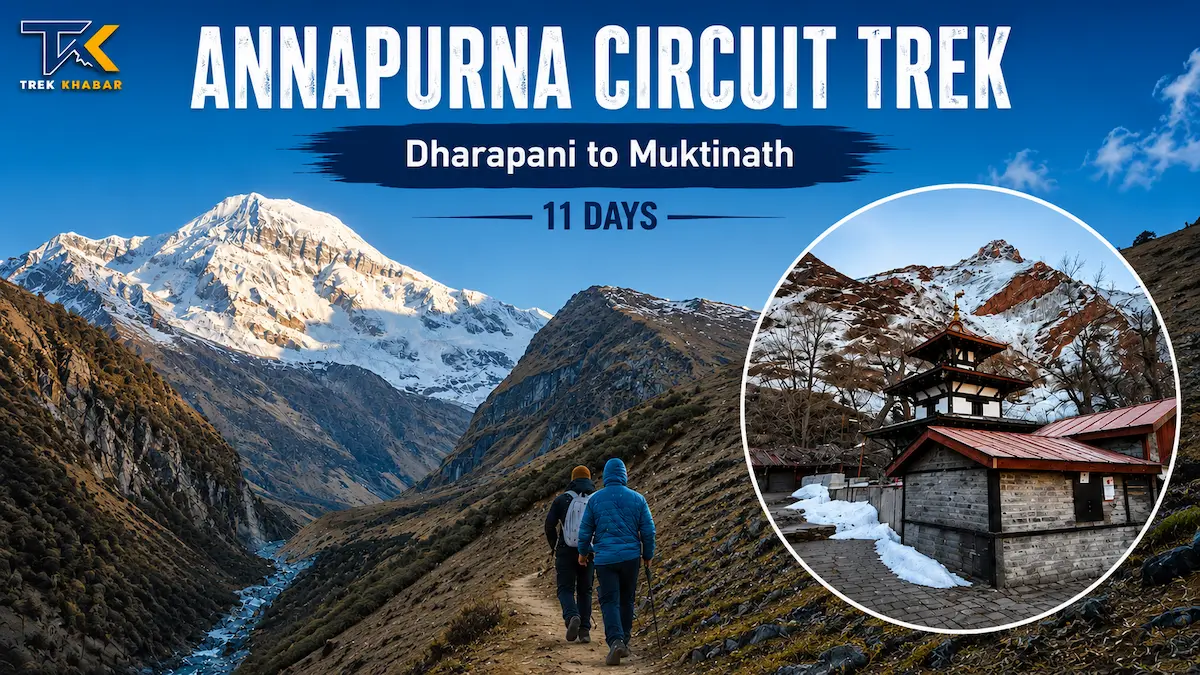
Some treks are simply about reaching a destination but The Annapurna Circuit is different. This trek journey is about walking through changing civilizations, climates, landscapes, religions and mountain ecosystems while slowly climbing into the high Himalayas. Every few hours, the scenery transforms so dramatically that it feels like trekking across multiple countries within a single expedition.
Beginning from Dharapani and ending at the sacred land of Muktinath after crossing the mighty Thorong La Pass (5,416m), this route remains one of Nepal’s most iconic trekking adventures. It combines raw Himalayan wilderness, ancient mountain culture, high-altitude challenge, and deep spiritual atmosphere into a single unforgettable experience.
Unlike shorter commercial treks, the Annapurna Circuit gives trekkers time to truly connect with the mountains. The trail gradually reveals its beauty from roaring rivers and pine forests to windswept valleys and snow-covered passes where the air itself feels thin and sacred.
Annapurna Circuit Trek Overview
| Trek Information | Details |
|---|---|
| Trek Name | Annapurna Circuit Trek |
| Route | Dharapani – Thorong La – Muktinath |
| Trek Duration | 12–15 Days |
| Highest Elevation | Thorong La Pass (5,416m) |
| Trek Difficulty | Moderate to Challenging |
| Accommodation | Tea Houses & Mountain Lodges |
| Best Seasons | Spring & Autumn |
| Transportation | Jeep / Bus |
| Region | Annapurna Conservation Area |
| Starting Point | Dharapani |
| Ending Point | Muktinath |
Trek Overview
Understanding the Annapurna Circuit Experience
The Annapurna region is special because of its extraordinary geographical diversity. Within a relatively short distance, trekkers in Annapurna Circuit move through:
- Subtropical valleys
- Deep river gorges
- Temperate forests
- Alpine meadows
- Glacier-fed landscapes
- Dry Himalayan rain-shadow near Mustang
This dramatic environmental transition happens because the Annapurna massif blocks monsoon clouds, creating completely different ecosystems on opposite sides of the mountains. The result is a trekking route that constantly changes in atmosphere, terrain, architecture, vegetation, and culture.
One day you will walk through green forests filled with waterfalls. A few days later, you are crossing barren Himalayan deserts beneath towering snow peaks. I assure very few trekking routes on Earth offer this level of contrast.
Why This Trek Feels Different From Other Himalayan Routes
The Annapurna Circuit is not only famous because of its mountains. It stands out because it creates a balanced Himalayan experience:
- Adventure
- Culture
- Spirituality
- Endurance
- Human connection
Trekkers don’t just observe the Himalayas here, they live inside them. The villages along the trail are active mountain communities where local traditions still shape daily life. Prayer wheels spin beside mule caravans. Ancient monasteries stand above steep valleys. Stone-built homes survive brutal winters through generations of adaptation.
This is not a manufactured trekking destination. It is a living Himalayan corridor.
Cultural Diversity Along the Trail
One of the most fascinating aspects of Annapurna Circuit trek is how culture gradually changes with altitude. Lower elevations are strongly influenced by Gurung traditions, while higher villages near Manang and Mustang reflect Tibetan Buddhist heritage.
As trekkers ascend, architecture becomes adapted for colder climates:
- flatter roofs,
- stone-built walls,
- smaller windows,
- enclosed courtyards.
Food, clothing, language, and even facial features begin to reflect trans-Himalayan culture. This gradual cultural transition gives the trek an educational depth that many mountain routes lack.
Detailed Trekking Itinerary
Day 1 — Kathmandu to Dharapani
The journey begins with a long overland drive through central Nepal. The road follows river valleys, terraced farmland, and mountain highways before eventually entering the Marsyangdi region. As urban areas disappear, rural Himalayan life becomes increasingly visible:
- suspension bridges,
- hillside villages,
- waterfalls,
- grazing animals,
- and distant snow peaks.
Dharapani serves as an important gateway between the lower hills and the higher Himalayan region. The atmosphere here immediately feels more remote and mountain-oriented.
Day 2 — Dharapani to Chame
The trail climbs gradually through dense forests filled with pine, fir, and oak trees. The Marsyangdi River remains a constant companion, often heard roaring far below the trail.
This section introduces trekkers to the rhythm of Himalayan trekking:
- slow ascents,
- suspension bridge crossings,
- tea house stops,
- and changing mountain views around every corner.
As elevation increases, temperatures become cooler and the surrounding peaks appear closer and more dramatic. Chame, the administrative center of Manang district, provides one of the first truly alpine environments of the trek.
Day 3 — Chame to Pisang
This section offers some of the most visually dramatic terrain of the lower circuit. Massive rock formations rise beside the trail while snowy peaks dominate the skyline. The valley widens significantly near Pisang, revealing enormous Himalayan panoramas that feel almost unreal in scale.
The transition from forested terrain to dry alpine landscape becomes increasingly noticeable here. Upper Pisang also introduces stronger Tibetan Buddhist influence through monasteries, prayer walls, and colorful flags carried by mountain winds.
Day 4 — Pisang to Manang
The route toward Manang is culturally rich and visually spectacular. Trekkers pass ancient settlements built to survive harsh Himalayan winters for centuries. Stone houses, yak pastures, and Buddhist shrines create an atmosphere that feels closer to Tibet than central Nepal.
The mountains surrounding Manang appear immense because the valley sits directly beneath several major Himalayan giants. At this stage of the trek, proper pacing becomes extremely important. Many trekkers underestimate how quickly altitude begins affecting the body above 3,500 meters.
Day 5 — Acclimatization in Manang
This is one of the most important days of the expedition. Acclimatization is not optional in the Annapurna Circuit — it is essential for safety. The human body needs time to adapt to decreasing oxygen levels at higher elevations. Without proper adjustment, altitude sickness can quickly become dangerous.
Trekkers usually spend the day hiking to higher viewpoints such as:
- Ice Lake,
- Gangapurna viewpoint,
- Braga Monastery,
- or nearby ridges above Manang.
These hikes stimulate altitude adaptation while allowing the body to recover overnight at a lower sleeping elevation.
Experienced guides often say:
“The mountain decides who climbs too fast.” and in the Himalayas, that statement is very true.
Day 6 — Manang to Yak Kharka
Beyond Manang, vegetation begins disappearing rapidly. Trees become rare, air becomes colder and drier and he landscape turns rugged and exposed. This region marks the beginning of true high-altitude trekking.
Walking speed naturally slows because oxygen availability decreases significantly above 4,000 meters. Even simple tasks require more energy:
- climbing stairs,
- carrying backpacks,
- or speaking while walking.
Yak Kharka itself is a small alpine settlement surrounded by grazing areas and barren hillsides shaped by harsh Himalayan weather.
Day 7 — Yak Kharka to Thorong Phedi
The trail gradually approaches the base of Thorong La Pass. This section is intentionally short because conserving energy becomes critical before summit day. Trekkers often feel both excitement and nervousness during this stage.
The mountains here feel colder, steeper, and more isolated than previous sections of the trek. Weather conditions can change rapidly:
- sunshine may turn into snowfall,
- strong winds can appear suddenly,
- temperatures drop dramatically after sunset.
Most trekkers sleep early because the pass crossing begins before dawn.
Day 8 — Thorong La Pass to Muktinath
This is the most physically demanding day of the trek. The ascent begins in darkness beneath freezing Himalayan skies. Headlamps form long moving lines across the mountainside as trekkers slowly climb toward the pass. At high altitude, success depends less on speed and more on consistency:
- steady breathing,
- controlled pacing,
- hydration,
- and mental discipline.
As sunrise reaches the snow-covered peaks, the surrounding Himalayas begin glowing gold and silver under early morning light. For many trekkers, this becomes the single most unforgettable moment of the journey.
After reaching the summit, the descent toward Muktinath is long and demanding on the knees, but the dramatic landscape transformation keeps the journey visually rewarding. The greener Annapurna side disappears behind you while the dry Mustang terrain opens ahead.
Day 9 — Muktinath to Tatopani
Today is all about relaxation and recovery after the Himalayan adventure with bus ride. The journey from Muktinath to Tatopani passes through beautiful mountain landscapes, waterfalls, and traditional villages along the Kali Gandaki Valley. As you descend to lower altitude, the weather becomes warmer and more comfortable. Upon arrival in Tatopani, enjoy the natural hot spring bath, well known for helping relax tired muscles and refreshing the body after days of travel and trekking. Spend the evening resting and enjoying the peaceful atmosphere.
Day 10 — Tatopani to Pokhara
Enjoy a comfortable Jeep ride from Tatopani to Pokhara along mostly blacktopped roads with scenic countryside views throughout the journey. Compared to the mountain trails, today’s ride is smooth, relaxing, and easygoing. After arriving in Pokhara, you can relax around Lakeside, enjoy local cafés and restaurants, or spend the evening by the beautiful Phewa Lake.
Day 11 — Roam Around Pokhara
Today is free for exploring the beautiful city of Pokhara. Visit popular attractions like Phewa Lake, Davis Falls, Gupteshwor Cave, World Peace Pagoda, and the vibrant Lakeside area. For adventure lovers, optional activities such as boating, paragliding, or zip-lining are also available. Enjoy your final day with beer and bar surrounded by stunning mountain views and a peaceful atmosphere.
Trek Difficulty Explained Honestly
The Annapurna Circuit is achievable for most healthy trekkers, but it should never be underestimated.
The challenge comes from:
- altitude,
- long trekking days,
- cold temperatures,
- physical fatigue,
- and changing mountain conditions.
This is not a technical climbing expedition. No ropes or mountaineering skills are required. However, endurance and patience are extremely important.
The people who struggle most are usually not the weakest physically but those who rush, ignore acclimatization, or underestimate altitude.
Understanding Altitude in the Himalayas
Altitude affects everyone differently. Fitness does not guarantee immunity from altitude sickness. A young athlete can become sick faster than an older slower trekker because altitude response depends largely on individual physiology and ascent rate.
Above 3,000 meters:
- oxygen pressure decreases,
- recovery slows,
- sleep quality changes,
- appetite may reduce,
- dehydration increases.
The safest strategy is simple: walk slowly and allow the body time to adapt.
The Himalayas reward patience.
Best Seasons for the Trek
Spring (March–May)
Spring offers:
- blooming rhododendron forests,
- moderate temperatures,
- colorful landscapes,
- stable weather.
This season creates a vibrant atmosphere across lower elevations.
Autumn (September–November)
Autumn is generally considered the best trekking season.
Post-monsoon skies are exceptionally clear, producing:
- sharp mountain visibility,
- stable weather,
- and ideal trekking temperatures.
Photography conditions during autumn are often extraordinary.
Winter Trekking Reality
Winter trekking is possible but much more serious.
Heavy snowfall can block Thorong La Pass completely.
Temperatures at high altitude may become dangerously cold, especially during storms or strong winds.
Only properly prepared trekkers should attempt the circuit in winter.
Food and Accommodation
Tea houses along the route provide simple but comforting mountain hospitality.
Rooms are basic, yet the communal dining halls become social centers where trekkers from around the world share stories, warmth, and trekking advice.
Meals are designed for energy and practicality.
Dal Bhat remains the most reliable trekking meal because it provides:
- carbohydrates,
- protein,
- hydration,
- and consistent energy.
Many experienced trekkers eventually stop chasing western food options and return to traditional Nepali meals for better recovery.
The Psychological Side of the Annapurna Circuit Trek
One part of Himalayan trekking people rarely discuss is the mental transformation.
After several days in the mountains:
- phone usage decreases,
- daily stress fades,
- sleep becomes deeper,
- conversations become simpler,
- priorities shift.
The rhythm of trekking changes human behavior in surprising ways.
People begin appreciating:
- warm tea,
- sunlight,
- breathing comfortably,
- and small achievements.
The mountains quietly remove unnecessary distractions.
That is one reason many trekkers describe the Annapurna Circuit as life-changing rather than simply adventurous.
Final Reflection
The Round Annapurna Circuit Trek is not merely a route across mountains.
It is a journey through elevation, culture, endurance, spirituality, and perspective.
The trail teaches patience through altitude.
It teaches humility through scale.
And it teaches gratitude through simplicity.
Long after the trek ends, most people do not remember only the mountains.
They remember:
- the silence before sunrise,
- the sound of prayer flags in the wind,
- the warmth of tea houses after cold days,
- conversations with strangers who became friends,
- and the feeling of standing high in the Himalayas realizing how vast the world truly is.
That is the real Annapurna Circuit Trek experience like one you made at Annapurna Base Camp.
