


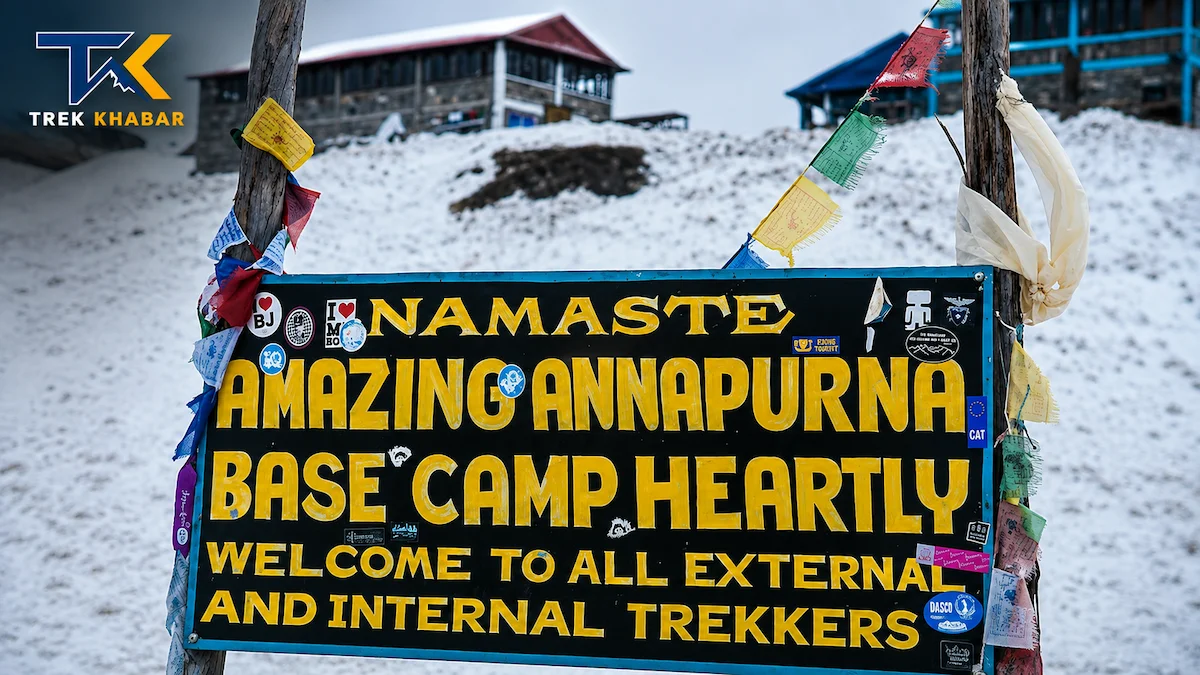
The Annapurna Base Camp Trek is not simply a walk to a mountain camp. It is a gradual journey into the hidden heart of the Himalayas — a natural sanctuary surrounded by towering snow giants, glacier valleys, sacred peaks, and ancient mountain villages.
Unlike high-pass expeditions that focus on extreme altitude, the Annapurna Base Camp Trek offers something more immersive and emotionally powerful: the feeling of entering deep inside the mountains themselves.
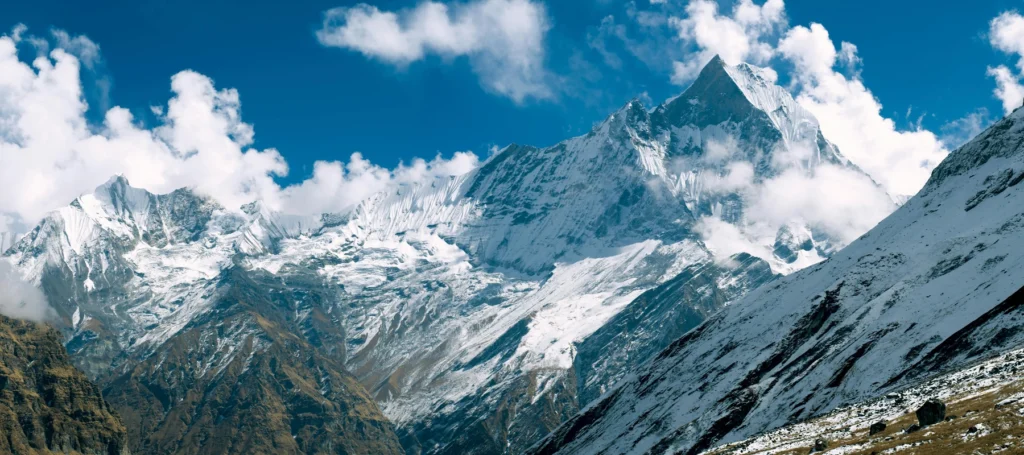
The trail slowly leads trekkers from warm terraced hills and rhododendron forests into a dramatic glacial amphitheater where Annapurna I, Machapuchare, Hiunchuli, and Annapurna South rise almost vertically above the valley floor.
At Annapurna Base Camp (4,130m), the mountains no longer feel distant. They surround you completely. That is what makes this trek unforgettable.
| Information | Details |
|---|---|
| Trek Name | Annapurna Base Camp Trek |
| Also Known As | ABC Trek / Annapurna Sanctuary Trek |
| Region | Annapurna Conservation Area |
| Duration | 7–14 Days |
| Maximum Altitude | Annapurna Base Camp (4,130m) |
| Trek Difficulty | Moderate |
| Accommodation | Tea House Trek |
| Best Seasons | Spring & Autumn |
| Starting Point | Nayapul / Jhinu / Ghandruk |
| Ending Point | Jhinu Danda / Pokhara |
| Transportation | Jeep / Bus |
| Trek Type | Lodge-Based Trekking |
Annapurna Base Camp lies inside the Annapurna Sanctuary — a glacial basin enclosed by Himalayan peaks above 7,000 and 8,000 meters
Why the Annapurna Base Camp Trek Is So Famous
Many Himalayan treks like Manaslu Circuit Trek offer mountain views, but very few allow trekkers to walk directly into the center of a massive Himalayan amphitheater.
The Annapurna Base Camp Trek is unique because the mountains gradually close around you day after day until you finally stand inside the sanctuary itself, surrounded in every direction by ice, rock, and snow.
The psychological effect is extraordinary.
Unlike viewpoints where mountains remain far away, ABC creates intimacy with the Himalayas. The scale becomes difficult to mentally process because the peaks rise directly above the trail.
Another reason the trek is globally popular is accessibility. Compared to Other Base Camp Treks or remote restricted-region treks:
- Logistics are easier,
- Altitude is lower,
- Tea houses are comfortable,
- The route is beginner-friendly with preparation.
The Annapurna Sanctuary Experience
The Annapurna Sanctuary is one of the most fascinating mountain landscapes in Nepal. This high glacial basin is protected by a ring of Himalayan giants:
- Annapurna I (8,091m)
- Annapurna South
- Machapuchare (Fishtail)
- Hiunchuli
- Gangapurna
The sanctuary has spiritual significance for local communities, particularly because Machapuchare is considered sacred and remains officially unclimbed.
As trekkers enter deeper into the valley, the environment changes dramatically:
- forests thin out,
- air becomes colder,
- vegetation disappears,
- Glacier rivers dominate the landscape.
Eventually, the mountains surround the trail. The result feels less like reaching a destination and more like entering a hidden Himalayan world.
Quick Trek Facts
| Category | Details |
|---|---|
| Highest Point | Annapurna Base Camp – 4,130m |
| Average Walking Hours | 5–7 Hours Daily |
| Total Distance | Approx. 110–120 km Round Trip |
| Accommodation | Tea Houses |
| Required Permits | ACAP & TIMS |
| Mobile Network | Limited at higher altitude |
| Wi-Fi Availability | Available in most villages |
| Hot Shower | Available with extra charge |
ABC is considered one of the best first high-altitude treks in Nepal because it combines genuine Himalayan scenery with relatively manageable altitude.
Detailed Day-by-Day Annapurna Base Camp Trek Itinerary
Day 1 — Kathmandu to Pokhara
The journey begins with a drive or short flight to Pokhara. Pokhara is Nepal’s trekking capital — a peaceful lakeside city beneath the Annapurna range. The atmosphere here is calm and adventurous, filled with trekkers preparing for Himalayan journeys.
Day 2 — Drive to Nayapul and Trek to Ghandruk
The trek begins through terraced farmland and traditional villages. Ghandruk is one of the most beautiful Gurung settlements in Nepal.
Stone-paved pathways, mountain homes, prayer flags, and distant Himalayan views create the perfect introduction to the Annapurna region.
Major Highlights
- Traditional Gurung culture
- Annapurna South views
- Machapuchare scenery
- Local mountain lifestyle
Day 3 — Ghandruk to Chhomrong
This section introduces the famous Annapurna staircases. The trail constantly ascends and descends through forests and hillside villages.
Many trekkers discover here that the challenge of ABC is not altitude alone — it is the endless stone steps. Chhomrong sits dramatically beneath Annapurna South and serves as the gateway into the sanctuary region.
What Makes This Day Difficult
- Continuous stair climbing
- Humidity in the lower sections
- Long ascent toward Chhomrong
The stone staircases around Chhomrong are considered among the physically toughest parts of the trek.
Day 4 — Chhomrong to Bamboo
The trail descends into dense bamboo and rhododendron forests beside the Modi Khola River.
This section feels completely different from previous days:
- Darker forests,
- Humid valleys,
- Waterfall crossings,
- Moss-covered trails.
The environment becomes quieter and more remote.
During spring, rhododendron forests bloom in brilliant red and pink colors across the hillsides.
Day 5 — Bamboo to Deurali
As elevation increases, the landscape begins transforming.
Dense forests slowly give way to alpine terrain.
The valley narrows dramatically while glacier rivers flow through rocky canyons below.
Trekkers begin feeling colder temperatures and thinner air.
This section also passes through avalanche-prone areas during winter and heavy snowfall periods, making weather awareness extremely important.
Day 6 — Deurali to Machapuchare Base Camp and Annapurna Base Camp
This is one of the most visually spectacular trekking days in Nepal.
The forest disappears completely.
The valley suddenly opens into the Annapurna Sanctuary, where snow-covered peaks rise in every direction.
The trail passes Machapuchare Base Camp before continuing toward Annapurna Base Camp itself.
At this stage, many trekkers stop speaking frequently because the landscape becomes overwhelming in scale.
The final approach to ABC feels surreal:
- Glaciers,
- Ice walls,
- Frozen rivers,
- The towering Himalayan cliffs dominate the sanctuary.
Peaks Visible from ABC
- Annapurna I
- Annapurna South
- Hiunchuli
- Machapuchare
- Gangapurna
The panoramic mountain amphitheater at ABC is considered one of the greatest mountain viewpoints in Nepal.
Day 7 — Sunrise at ABC and Trek Down to Bamboo
Sunrise at Annapurna Base Camp is often the emotional peak of the journey.
As morning sunlight slowly reaches the sanctuary walls, the mountains glow gold, orange, and silver beneath the cold Himalayan sky.
The silence here feels profound.
Unlike crowded viewpoints elsewhere, ABC mornings often feel deeply personal and reflective.
After breakfast, trekkers descend toward Bamboo.
Descending may sound easier, but long downhill sections place heavy pressure on knees and leg muscles.
Day 8 — Bamboo to Jhinu Danda
The trail returns through forests and villages before reaching Jhinu Danda.
Jhinu is famous for its natural hot springs beside the river.
After several days of trekking, soaking in the warm mineral water becomes one of the most satisfying experiences of the journey.
The contrast between freezing mountain mornings and warm riverside springs feels almost therapeutic.
Day 9 — Trek to Nayapul and Return to Pokhara
The final trekking section passes through cultivated farmland, villages, and river valleys before reaching the road connection back to Pokhara.
Returning to city life after days inside the Himalayas often feels emotionally strange.
Many trekkers realize the mountains changed their mental rhythm more deeply than expected.
Trek Difficulty Explained Honestly
The Annapurna Base Camp Trek is considered moderate difficulty.
That description is accurate — but incomplete.
The challenge does not come from technical climbing.
The real difficulty comes from:
- Repeated ascents and descents,
- Thousands of stone steps,
- Consecutive trekking days,
- Changing temperatures,
- Moderate altitude exposure.
ABC is physically tiring rather than technically dangerous. Most reasonably fit trekkers can complete it successfully with preparation.
Is Annapurna Base Camp Suitable for Beginners?
Yes — and this is one reason ABC is globally popular.
For beginners, the trek offers:
- Excellent tea house infrastructure,
- Lower altitude than Everest Base Camp,
- Manageable trekking days,
- Safer acclimatization profiles.
However, beginners should not underestimate:
- The stair climbing,
- Physical fatigue,
- Mountain weather.
First-time trekkers who train properly usually enjoy the trek much more.
Altitude and Acclimatization
Although ABC is lower than many Himalayan treks, altitude still matters.
Above 3,000 meters:
- Oxygen decreases,
- Recovery slows,
- Dehydration increases,
- Sleep quality changes.
Some trekkers experience mild altitude symptoms:
- Headache,
- Fatigue,
- Dizziness,
- Reduced appetite.
The best prevention strategy:
- Walk slowly,
- Hydrate constantly,
- Avoid alcohol,
- Sleep properly,
- Never rush uphill.
ABC altitude is generally manageable compared to higher Himalayan routes, but proper pacing remains essential.
Best Time for Annapurna Base Camp Trek
Spring (March–May)
Spring transforms the lower trail into a colorful Himalayan forest.
Why Spring Is Popular
- Rhododendron blooms
- Warmer temperatures
- Green landscapes
- Stable mornings
This is the most visually colorful season.
Autumn (September–November)
Autumn is considered the best overall trekking season.
Advantages
- Crystal-clear mountain visibility
- Stable weather
- Dry trails
- Excellent photography conditions
October is often considered the ideal trekking month for ABC.
Winter Trekking
Winter offers:
- Fewer crowds,
- Peaceful trails,
- Dramatic snowy scenery.
But temperatures can become extremely cold above Deurali, and snowfall may affect trail safety.
Monsoon Trekking
Monsoon season is generally not recommended because of:
- Landslides,
- Leeches,
- Slippery trails,
- Cloud-covered mountains.
Trail conditions become significantly more difficult during monsoon months.
Accommodation During the Trek
Tea houses provide:
- Basic twin rooms,
- Blankets,
- Communal dining halls,
- Charging facilities,
- Wi-Fi,
- Hot showers.
Facilities become simpler at higher elevations.
The dining halls are often the social heart of the trek where trekkers from around the world share stories beside warm stoves.
Food on the Trek
ABC tea houses provide surprisingly diverse menus.
Common Meals
- Dal Bhat
- Fried rice
- Noodles
- Soup
- Pasta
- Tibetan bread
- Pancakes
- Eggs
- Momos
Experienced trekkers often rely heavily on Dal Bhat because it provides long-lasting energy for trekking days.
Packing List for ABC Trek
Clothing
- Down jacket
- Thermal layers
- Waterproof jacket
- Trekking pants
- Gloves
- Warm hat
Trekking Equipment
- Trekking boots
- Backpack
- Trekking poles
- Sleeping bag
- Headlamp
Health & Safety
- Water purification tablets
- Sunscreen
- Lip balm
- Personal medication
- Basic first aid kit
Trekking poles are especially useful because of the continuous stair sections.
Mental Preparation for the Trek
One of the least discussed aspects of Himalayan trekking is mental adaptation.
After several days on the trail:
- Phones matter less,
- Schedules disappear,
- Conversations become deeper,
- Simple comforts become meaningful.
The mountains simplify life.
Trekkers begin appreciating:
- Warm tea,
- Sunlight after cold mornings,
- Quiet forests
- Steady breathing during difficult climbs.
That psychological reset is one reason many people return to the Himalayas repeatedly.
Why Annapurna Base Camp Changes People
There are treks with higher altitude numbers. There are treks with greater technical difficulty. But few treks create emotional immersion the way Annapurna Base Camp does. Because the sanctuary surrounds you completely, the experience feels deeply personal rather than observational.
You do not stand far away looking at mountains. You stand inside them. And somewhere between the forests of Chhomrong, the frozen silence of the sanctuary, and the sunrise beneath Annapurna I, many trekkers discover that the journey became larger than trekking itself. That is the true magic of Annapurna Base Camp.
