


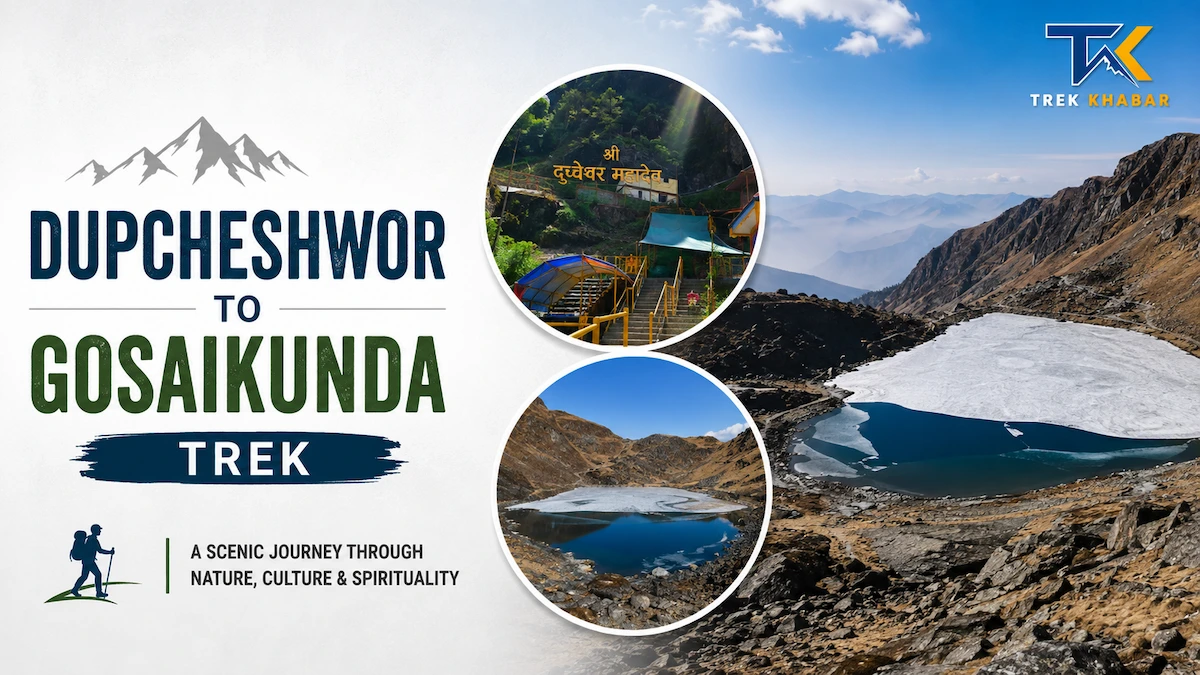
The Dupcheshwor to Gosaikunda Trek is a beautiful and less commonly discussed way to reach one of Nepal’s most sacred Himalayan lakes. Instead of following the more established route from Dhunche, this journey approaches Gosaikunda from the Dupcheshwor side of Nuwakot, taking trekkers through rural villages, forests, steep mountain trails and high altitude landscapes before reaching the sacred lakes around Gosaikunda.
What makes this trek special is the way the scenery and atmosphere change as you climb. The journey begins among farms, villages and green hills around Nuwakot, passes the spiritually important Dupcheshwor Mahadev Temple, and gradually moves into a much quieter mountain environment. By the time you reach Suryakunda and Gosaikunda, the landscape has completely changed into a rugged alpine world.
Gosaikunda itself sits at around 4,380 meters, while Suryakunda on the approach is around 4,600 meters or higher, depending on the exact point measured. That means this is not simply a short village hike. The route involves a significant elevation gain, and proper pacing and preparation are essential.
For trekkers who want something different from the usual Gosaikunda itinerary, the Dupcheshwor approach offers a rewarding combination of nature, local culture, Hindu pilgrimage and Himalayan adventure.
Dupcheshwor to Gosaikunda Trek at a Glance
| Trek Detail | Information |
|---|---|
| Starting area | Dupcheshwor, Nuwakot |
| Main destination | Gosaikunda |
| Region | Nuwakot and Langtang region |
| Gosaikunda altitude | Approximately 4,380 m |
| Highest point | Around Suryakunda, approximately 4,600 m |
| Difficulty | Moderate to challenging |
| Recommended duration | 4 to 6 days |
| Best seasons | Spring and autumn |
| Trek type | Pilgrimage, village and alpine trek |
| Main attractions | Dupcheshwor Temple, Suryakunda, Gosaikunda and surrounding lakes |
| Accommodation | Homestays, teahouses and basic mountain lodges |
| Suitable for | Prepared hikers, pilgrims and experienced trekkers |
The exact duration and walking distance can vary because road access and the practical starting point of the walking section can change. Some itineraries use vehicles farther into the Nuwakot side before beginning the main climb.
What Is the Dupcheshwor to Gosaikunda Trek?
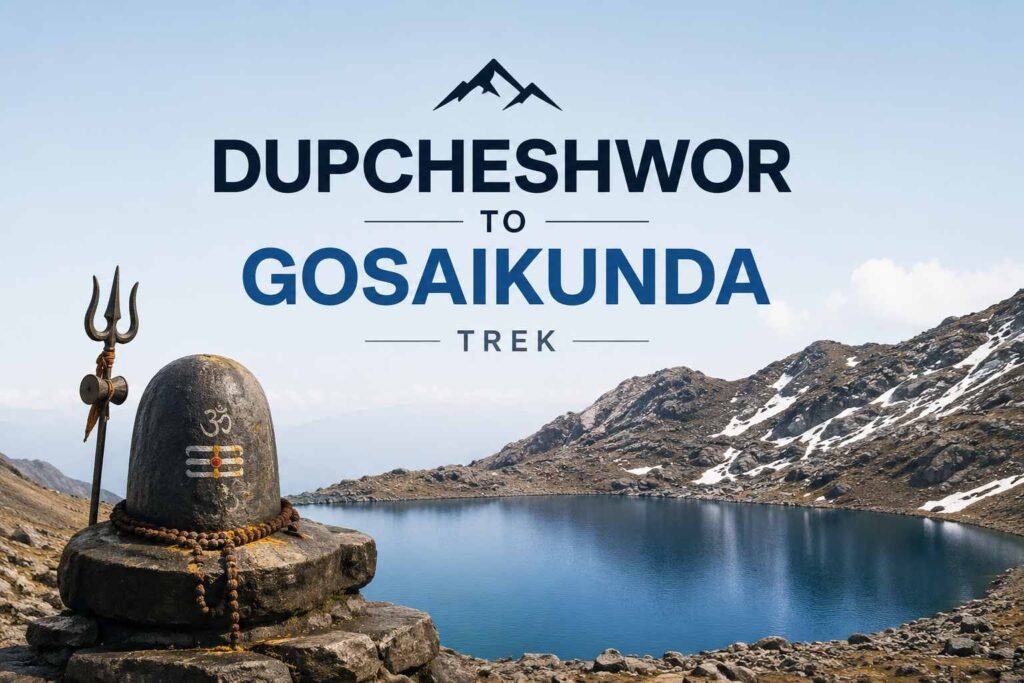
The Dupcheshwor to Gosaikunda Trek is an alternative trekking route to Gosaikunda that approaches the sacred lake from the Nuwakot side.
The journey begins around Dupcheshwor, an important pilgrimage destination known for Dupcheshwor Mahadev Temple. From there, the route continues through rural settlements and gradually gains elevation before entering the higher mountain landscape.
Depending on the itinerary and current road conditions, trekkers may pass through areas such as Sisipu, Ghyangphedi and Phedi before continuing toward Suryakunda and Gosaikunda.
The route is particularly interesting because it does not feel like a conventional tourist trail in its lower sections. You get to see everyday life in the mountain villages before the landscape becomes increasingly wild and alpine.
As you gain altitude, houses become less frequent, farmland gives way to forests and open slopes, and eventually the trail reaches the sacred lakes of the high Himalayas.
Why Trek to Gosaikunda via Dupcheshwor?
There are several established ways to reach Gosaikunda, so choosing Dupcheshwor is mainly about the experience.
The route gives you an opportunity to explore a less conventional side of the Gosaikunda region. Instead of starting directly from the popular trekking gateway of Dhunche, you begin your journey among the rural communities of Nuwakot.
One of the biggest attractions is the combination of landscapes.
You can experience:
- Traditional mountain villages
- Terraced farmland
- Forested hills
- Steep mountain trails
- High altitude ridges
- Sacred alpine lakes
- Hindu pilgrimage sites
- Local mountain culture
The route also provides a natural connection between two important religious destinations, Dupcheshwor Mahadev and Gosaikunda.
For pilgrims, this adds a deeper meaning to the trek. For hikers, it creates a journey that feels more varied than simply walking toward a lake.
Dupcheshwor Mahadev: The Spiritual Beginning
Dupcheshwor Mahadev Temple gives this trek a distinctly spiritual beginning. The temple is located in Nuwakot and is an important pilgrimage site dedicated to Lord Shiva. Many visitors come here specifically for religious purposes, while others include the temple as part of their journey toward the Himalayan region.
Starting your trek from this area allows the religious aspect of the Gosaikunda journey to begin before you reach the high mountains.
This is particularly meaningful because Gosaikunda is also strongly associated with Lord Shiva.
According to Hindu tradition, Lord Shiva created Gosaikunda after striking the ground with his trident. The lake is believed to have been formed after Shiva consumed poison during the churning of the cosmic ocean and needed a source of water to cool himself.
Whether you approach the story from a religious or cultural perspective, it helps explain why Gosaikunda has remained such an important pilgrimage destination for generations.
Dupcheshwor to Gosaikunda Trek Route
The exact route can vary according to local road conditions, seasonal trail conditions and the point where your vehicle journey ends.
A commonly described approach travels through the Dupcheshwor, Sisipu and Ghyangphedi areas, followed by a steep climb toward Phedi and the high-altitude landscape around Suryakunda.
Some itineraries use road transport farther along the Nuwakot side and begin the main walking section from a higher settlement.
This is important when calculating the trek’s distance and duration. Two people can both say they completed the “Dupcheshwor to Gosaikunda Trek” while actually walking different distances because their vehicles reached different points.
For that reason, it is better to think of the route in terms of its major sections rather than relying on one fixed kilometer figure.
Day 1: Kathmandu to Dupcheshwor and the Nuwakot Villages
The journey normally begins with a drive from Kathmandu toward Nuwakot.
As you leave the Kathmandu Valley, the landscape gradually becomes more rural. Urban development gives way to hills, farmland, forests and scattered villages.
After reaching the Dupcheshwor area, you can visit Dupcheshwor Mahadev Temple before continuing toward your overnight destination.
Depending on the road and itinerary, the vehicle may continue toward areas such as Sisipu or Ghyangphedi.
The first day is generally more about transportation and getting into the mountain environment than completing a major hiking section.
It is worth taking your time here.
The lower part of the trek is where you can see traditional houses, terraced fields, local farms and everyday village life. These details are easy to overlook if you treat the journey simply as a race toward Gosaikunda.
Day 2: Sisipu or Ghyangphedi to Phedi
The trek becomes considerably more demanding as you leave the lower villages.
The trail begins climbing toward the higher settlements and mountain slopes. The change in altitude becomes increasingly noticeable, especially if you have started the walking section from a relatively low elevation.
Phedi is an important point on the route because from here the trek enters the higher-altitude environment.
One of the characteristics of this section is that the distance can be misleading.
A trail that looks short on a map can still take several hours when it involves continuous steep climbing.
The best strategy is to walk slowly and maintain a comfortable rhythm rather than trying to reach Phedi quickly.
Day 3: Phedi to Suryakunda and Gosaikunda
This is the most demanding and exciting part of the journey.
From Phedi, the landscape becomes increasingly alpine. Trees become less dominant, the trail becomes more exposed and the surrounding mountains start to feel much closer.
The route continues toward Suryakunda, which is one of the high points of the journey.
At this elevation, even a moderate uphill trail can feel difficult because the air contains less oxygen than at lower elevations.
Take frequent breaks.
Drink water.
Eat properly.
And pay attention to how your body feels.
After crossing the high section around Suryakunda, the route continues toward the Gosaikunda area.
The first sight of the lake after climbing for days can be one of the most memorable moments of the entire trek.
Day 4: Gosaikunda and Return
Once you reach Gosaikunda, you can spend some time exploring the lake and surrounding landscape before beginning the descent.
Depending on your itinerary, you may return through the same general route or connect with another established Gosaikunda trekking route.
The descent is physically easier in terms of oxygen availability, but steep downhill walking can still be hard on the knees.
Do not assume that the difficult part is over simply because you are going downhill.
Suryakunda: The High Point of the Route
Suryakunda is one of the most interesting parts of the Dupcheshwor approach.
The area sits at a higher elevation than Gosaikunda and forms part of the sacred lake landscape surrounding the region.
The environment here is dramatically different from the lower hills.
There are fewer trees, more exposed rock and open mountain slopes. The weather can change quickly, and clouds can appear over the ridges without much warning.
The surrounding lakes and religious sites also make this area culturally significant.
If conditions are clear, the views can be spectacular.
If clouds or snow arrive, however, the same landscape can become much harder to navigate.
This is one of the reasons experienced local guidance is particularly useful on the high sections.
Reaching Gosaikunda Lake
Gosaikunda is the main destination of the trek.
At approximately 4,380 meters, the lake is surrounded by rugged mountain terrain and several other sacred lakes.
The scenery can be difficult to describe properly until you see it yourself.
The lower sections of the trek are green and populated, while the area around Gosaikunda feels stark and almost otherworldly.
The blue or blue-green water of the lake contrasts sharply with the rocky mountain slopes around it.
For many trekkers, the lake itself is only part of the experience.
The silence, altitude, cold air and surrounding mountains create a feeling that is completely different from the lower Himalayan foothills.
Religious Importance of Gosaikunda
Gosaikunda is one of Nepal’s most important high-altitude pilgrimage destinations.
Hindu devotees associate the lake strongly with Lord Shiva and believe its waters have sacred significance.
The lake becomes especially important during Janai Purnima, when thousands of pilgrims travel to the region.
Many devotees bathe in the lake as part of their religious observance.
The wider region also contains Buddhist cultural influences, making the journey an interesting example of the overlapping religious traditions found throughout the Himalayan landscape.
For some people, Gosaikunda is primarily a pilgrimage destination.
For others, it is a trekking destination.
For many visitors, it is both.
Recommended 5 Day Dupcheshwor to Gosaikunda Itinerary
A five-day itinerary gives you more breathing room than trying to complete the journey as quickly as possible.
Day 1: Kathmandu to Dupcheshwor and Sisipu
Drive from Kathmandu toward Dupcheshwor.
Visit Dupcheshwor Mahadev Temple and continue toward the next settlement according to road conditions.
Overnight in a local homestay or basic accommodation.
Day 2: Sisipu to Phedi
Begin the main uphill walking section.
The trail gradually climbs through mountain terrain toward Phedi.
Take regular breaks and focus on maintaining a slow, sustainable pace.
Overnight around Phedi.
Day 3: Phedi to Suryakunda and Gosaikunda
This is the major high-altitude day.
Start early and climb gradually toward Suryakunda.
Continue through the high-altitude landscape toward Gosaikunda.
Spend the night around the lake if accommodation is available and conditions allow.
Day 4: Explore Gosaikunda and Descend
Spend some time around Gosaikunda in the morning.
Enjoy the surrounding scenery and visit nearby religious sites if conditions and time permit.
Begin descending toward a lower settlement.
Day 5: Return to Kathmandu
Continue descending toward the road-accessible area and travel back toward Kathmandu.
The exact transport arrangement will depend on where you finish the walking section.
Can the Trek Be Done in 3 or 4 Days?
Yes, a shorter itinerary is possible.
Strong trekkers with good logistical planning may be able to complete the journey in four days, particularly if vehicles can travel farther along the lower route.
However, shorter does not necessarily mean better.
The biggest concern is the rapid gain in altitude.
Trying to save one day can mean spending longer periods at high elevation without enough time for your body to adjust.
If you are unfamiliar with high-altitude trekking, adding an extra day is usually a better decision than trying to make the itinerary as short as possible.
How Difficult Is the Dupcheshwor to Gosaikunda Trek?
The trek is best described as moderate to challenging.
There is no technical mountaineering involved under normal conditions, but the route demands reasonable fitness and preparation.
The main challenges include:
- Long uphill sections
- Steep trails
- Rapid elevation gain
- High-altitude walking
- Cold weather
- Limited accommodation
- Changing mountain weather
- Remote sections
- Reduced oxygen above 4,000 meters
The steepness is more important than the total distance.
A short climb with a large elevation gain can be much harder than a longer trail that climbs gradually.
Who Can Do This Trek?
You do not need to be an elite athlete.
People who regularly walk, hike, run or exercise can prepare for the route.
The most important thing is being comfortable with several hours of uphill walking.
If you rarely exercise, spend most of your day sitting and have little hiking experience, you should spend several weeks preparing before attempting the trek.
Previous Himalayan trekking experience is useful but not essential.
Altitude and Acclimatization
Altitude is the biggest concern on this trek.
The route moves from relatively low mountain elevations to more than 4,000 meters in a relatively short period.
Physical fitness does not completely protect you from altitude sickness.
Even very fit people can experience problems if they ascend too quickly.
Walk slowly.
Stay hydrated.
Eat regularly.
Get enough sleep.
Most importantly, do not continue ascending if your symptoms are becoming worse.
Symptoms of Altitude Sickness
Common symptoms can include:
- Headache
- Dizziness
- Nausea
- Loss of appetite
- Unusual tiredness
- Difficulty sleeping
- Shortness of breath
More serious symptoms include confusion, severe breathlessness, difficulty walking and rapidly worsening symptoms.
Those symptoms should be treated as an emergency rather than something to simply “push through.”
What to Do if You Develop Altitude Sickness
If symptoms are mild, stop ascending and rest while monitoring yourself.
If symptoms worsen or become severe, descending to a lower elevation is important.
Never allow a fixed itinerary to become more important than your health.
A good guide should be willing to change the schedule when weather or altitude makes continuing unsafe.
Best Time for the Dupcheshwor Gosaikunda Trek
The best seasons are generally spring and autumn.
These seasons offer a good balance of weather, visibility and trail conditions.
Spring: March to May
Spring is a beautiful time to visit the region.
The lower hills become greener, forests become lively and rhododendrons can add color to the landscape.
Temperatures are generally pleasant at lower elevations, although nights at high altitude remain cold.
April and May are particularly attractive for trekkers who want good weather and spring scenery.
Autumn: September to November
Autumn is one of the most reliable trekking seasons in Nepal.
After the monsoon, the air is often clear and mountain visibility can be excellent.
October and November are particularly popular for Himalayan trekking.
If your priority is clear mountain views and relatively stable conditions, autumn is an excellent choice.
Winter Trekking
Winter trekking is possible but requires additional preparation.
Snow and ice can affect the higher sections of the trail.
Temperatures around Suryakunda and Gosaikunda can become extremely cold, particularly at night.
Anyone planning a winter trip should check current weather and trail conditions rather than assuming the route will be accessible.
Monsoon Trekking
Monsoon is generally not the easiest time for this trek.
The lower hills can receive heavy rainfall, trails may become muddy and slippery, and landslides can affect roads.
Clouds can also block mountain views.
However, the monsoon period has a major cultural attraction because Janai Purnima usually falls during this period, bringing many pilgrims toward Gosaikunda.
Accommodation on the Dupcheshwor Route
Accommodation is more basic than on Nepal’s busiest trekking routes.
In lower villages, you may find local homestays and small guesthouses.
As you climb higher, accommodation becomes more limited.
Do not expect luxury hotels.
A typical mountain lodge may offer a simple room, basic bedding and shared bathroom facilities.
Food may be prepared by the same family that runs the lodge.
This simplicity is part of the experience.
It also means that you should not depend on being able to find accommodation exactly where you planned to stop.
Local guides can be extremely helpful because they know the current situation in the villages and can arrange overnight stays in advance.
Food on the Trek
Food becomes simpler as you climb higher.
You should focus on meals that provide enough energy without being difficult to digest.
Dal Bhat
Dal bhat is one of the best trekking meals in Nepal.
Rice, lentils, vegetables and pickles provide a filling combination of carbohydrates and protein.
It is also familiar, affordable and widely available.
Noodles and Thukpa
Noodles are another common option.
Thukpa is particularly enjoyable when the weather becomes cold because it is a hot noodle soup.
Eggs and Simple Breakfasts
Eggs, bread, porridge and similar simple meals are useful in the morning.
At altitude, you may not feel especially hungry, but skipping meals can make long hiking days harder.
Drinking Water and Hydration
Proper hydration is important throughout the trek.
Carry a reusable water bottle or hydration system and use treated water when necessary.
Water purification tablets or a reliable filter can be useful.
Do not assume that a clear mountain stream is automatically safe to drink.
The cold, dry air and physical effort can make dehydration easier to overlook.
Drink regularly rather than waiting until you are extremely thirsty.
Dupcheshwor to Gosaikunda Trek Cost
The cost depends heavily on how you organize the journey.
There is no single fixed price because transportation, accommodation, guide services and trek duration can vary.
Your main expenses will include:
- Transportation
- Food
- Accommodation
- Guide
- Porter
- Permits
- TIMS
- Personal expenses
- Emergency or insurance costs
Transportation Cost
Transportation can be a major part of the budget because the exact road-access point depends on local conditions.
Shared public transport is normally cheaper.
A private jeep provides more flexibility but can significantly increase the total cost.
Accommodation and Food Cost
Basic homestays and teahouses are generally more affordable than hotels.
Prices usually increase at higher elevations because supplies are harder to transport.
Food prices can therefore be noticeably higher near the high-altitude sections than in Kathmandu or lower villages.
Guide and Porter Cost
Guide and porter rates depend on the season, agency, trek duration and services included.
For foreign trekkers, current trekking regulations also make the guide component particularly important.
A porter can be useful if you want to keep your personal backpack light.
Permit and TIMS Cost
Foreign trekkers should budget for the applicable Langtang National Park entry permit and TIMS requirements.
Permit rules and fees can change, so confirm the current requirements before departure rather than relying on an old trekking blog.
Permits for the Dupcheshwor to Gosaikunda Trek
Gosaikunda lies within the Langtang National Park area.
Foreign trekkers should therefore make sure they have the appropriate national park entry permit and trekking documentation.
Current Nepal Tourism Board guidance includes Gosaikunda among the trekking routes where foreign trekkers are required to have a licensed guide and agency-issued TIMS card.
Because regulations can change, it is best to confirm the current requirements with the Nepal Tourism Board or a registered trekking agency immediately before your trip.
Do not assume that because you start in Nuwakot, you do not need permits for the Gosaikunda section.
Do You Need a Guide?
For foreign trekkers entering the applicable Langtang trekking routes, current regulations require a licensed guide and TIMS arranged through a registered trekking agency.
Even aside from regulations, a guide is useful on this particular route.
The Dupcheshwor approach is less straightforward than the established Dhunche route.
A local guide can help with:
- Navigation
- Accommodation
- Transportation
- Communication
- Weather decisions
- Altitude management
- Emergency situations
- Local cultural practices
For domestic trekkers, the legal requirements may differ, but having someone familiar with the route remains a sensible choice.
What to Pack for the Trek
Packing light is important, but you should not leave behind essential cold-weather equipment.
Clothing and Footwear
Bring:
- Moisture-wicking base layers
- Warm fleece or mid-layer
- Insulated jacket
- Waterproof jacket
- Trekking trousers
- Thermal underwear
- Warm hat
- Gloves
- Warm socks
- Comfortable trekking shoes
Your trekking shoes should already be broken in.
A brand-new pair can cause painful blisters during a multi-day trek.
Personal and Safety Items
Useful items include:
- Sunscreen
- Sunglasses
- Lip balm
- Personal medication
- Basic first-aid supplies
- Water bottle
- Water purification tablets or filter
- Headlamp
- Snacks
- Toiletries
- Hand sanitizer
Electronics and Documents
Bring:
- Phone
- Power bank
- Charging cables
- Offline maps
- Identification
- Required permits and documents
- Emergency contact information
Keep important documents protected from rain and moisture.
Mobile Network and Internet
Do not plan the trek assuming that mobile data will work everywhere.
Coverage can vary significantly between villages and high-altitude areas.
Download maps before leaving Kathmandu.
A power bank is also useful because charging opportunities can become limited in remote settlements.
It is a good idea to tell family or friends your expected itinerary before starting the trek.
Wildlife and Nature
The wider Langtang region is known for its diverse Himalayan ecosystem.
Lower sections of the route pass through forests where you may see different species of birds and other wildlife.
Do not expect wildlife sightings every day.
The best approach is simply to walk quietly and respect the environment.
Never feed wild animals.
Do not leave food packaging behind.
Carry your rubbish until you find a proper disposal point.
Photography on the Trek
The route offers plenty of opportunities for photography because the landscape changes so dramatically.
The lower villages are excellent for cultural and landscape photography.
Forest sections can look particularly atmospheric in the morning when mist hangs between the trees.
The high-altitude section is completely different.
Open ridges, rocky slopes, mountain lakes and changing clouds create dramatic compositions.
Gosaikunda itself is obviously the main photographic attraction, but do not ignore the smaller lakes and surrounding ridges.
Morning and late afternoon often provide beautiful light.
Dupcheshwor Route vs Dhunche Route
The Dupcheshwor and Dhunche approaches offer two very different experiences.
| Feature | Dupcheshwor Route | Dhunche Route |
|---|---|---|
| Starting area | Nuwakot | Dhunche |
| Trail character | Less conventional | Established |
| Village experience | Strong | Moderate |
| Infrastructure | More limited | Better developed |
| Navigation | More complicated | Easier |
| High-altitude ascent | Can be rapid | More established |
| Crowd level | Generally quieter | More popular |
| Best for | Adventure and alternative experience | First-time Gosaikunda trekkers |
The Dhunche route is easier to organize and has more established trekking infrastructure.
The Dupcheshwor route is better suited to people who want a quieter and more unusual approach.
Dupcheshwor to Gosaikunda vs Langtang Gosaikunda Trek
These two itineraries should not be confused.
The Dupcheshwor route focuses on reaching Gosaikunda from the Nuwakot side.
The Langtang Gosaikunda trek is a much longer Himalayan journey that can include places such as Lama Hotel, Langtang Village and Kyanjin Gompa before continuing toward Gosaikunda.
If you only have four to six days, Dupcheshwor can make more sense.
If you have around two weeks and want a much more comprehensive Himalayan experience, combining Langtang Valley with Gosaikunda offers considerably more variety.
Trekking During Janai Purnima
Janai Purnima is one of the most important times of year at Gosaikunda.
Thousands of pilgrims travel toward the lake to take part in religious rituals and bathe in its sacred waters.
The atmosphere during this period is completely different from an ordinary trekking season.
The trail becomes busier and accommodation can become more difficult to secure.
If your primary goal is pilgrimage, this can be a very meaningful time to visit.
If you want solitude and quiet trails, autumn outside the main pilgrimage period is a better choice.
Important Safety Tips
The Dupcheshwor route should be approached with respect.
Don’t Rush the Altitude
The most important rule is to avoid gaining altitude too quickly.
Walk slowly and give your body time to adjust.
Check the Weather
Mountain weather can change rapidly.
A sunny morning does not guarantee good conditions throughout the day.
Carry Enough Water
Always make sure you have sufficient water before beginning a long or remote section.
Keep Your Phone Charged
Your phone can be useful for navigation and emergencies, although you should not depend on it as your only safety system.
Carry Offline Maps
Download maps before leaving areas with reliable internet.
Respect Religious Sites
Gosaikunda and the surrounding lakes are sacred.
Follow local customs and avoid disturbing religious activities.
Common Mistakes to Avoid
One of the biggest mistakes is underestimating the trek because the overall journey is relatively short.
Another is trying to maintain the same walking speed at 4,000 meters that you would use at sea level.
Other common mistakes include:
- Packing too much
- Wearing untested trekking shoes
- Not drinking enough water
- Ignoring early altitude symptoms
- Starting late on high-altitude days
- Assuming mobile coverage will always work
- Relying entirely on old online route information
- Failing to check accommodation availability
- Ignoring changing weather conditions
A slower and better-prepared trek is almost always more enjoyable than an unnecessarily rushed one.
Is Dupcheshwor to Gosaikunda Suitable for Beginners?
It can be, but preparation matters.
A fit beginner who regularly walks and has prepared for uphill hiking can potentially complete the route with a suitable itinerary and local guidance.
However, this is not a casual weekend hike.
The altitude is the main factor that separates this trek from ordinary hill walks around Kathmandu.
If you have never trekked above 3,000 meters before, consider giving yourself more time and using a knowledgeable guide.
Is the Dupcheshwor to Gosaikunda Trek Worth It?
Yes, particularly if you want to experience Gosaikunda from a different perspective.
The standard Dhunche route remains the easier choice for many first-time visitors, but Dupcheshwor offers something different.
You begin with the spiritual atmosphere of Dupcheshwor Mahadev.
Then you move through rural Nuwakot.
The landscape gradually changes from farmland and forest to high mountain terrain.
Eventually, you reach Suryakunda and the sacred waters of Gosaikunda.
That progression is what makes the trek memorable.
It is not simply about reaching the lake.
It is about experiencing the gradual transformation from the populated middle hills to the quiet, rugged landscape of the high Himalayas.
Frequently Asked Questions
How long does the Dupcheshwor to Gosaikunda Trek take?
The trek can generally be arranged in around four to six days, depending on transportation, the exact starting point of the walking section, walking pace and the chosen return route. Adding an extra day can make the journey more comfortable, particularly for trekkers who are not accustomed to high altitude.
What is the highest altitude on the Dupcheshwor to Gosaikunda Trek?
The route reaches approximately 4,600 meters around Suryakunda, while Gosaikunda itself is approximately 4,380 meters above sea level.
How difficult is the Dupcheshwor to Gosaikunda Trek?
It is a moderate to challenging trek. The main difficulties are steep climbs, rapid elevation gain, cold weather and reduced oxygen at high altitude rather than technical climbing.
What is the best month for the Dupcheshwor to Gosaikunda Trek?
October and November are excellent months because autumn generally provides stable weather and good visibility. April and May are also good choices, especially if you want spring scenery.
Can beginners do the Dupcheshwor to Gosaikunda Trek?
Fit beginners can potentially complete the trek with proper preparation and guidance. However, because of the rapid gain in altitude, beginners should avoid rushing and should consider allowing additional days for acclimatization.
Is Gosaikunda higher than Suryakunda?
No. Suryakunda is higher. Suryakunda is approximately 4,600 meters, while Gosaikunda is around 4,380 meters.
Do I need a guide for the Dupcheshwor to Gosaikunda Trek?
Foreign trekkers entering the applicable Langtang trekking routes currently need a licensed guide and the required TIMS documentation. Even where not legally required, a local guide is strongly recommended because the Dupcheshwor route is less established than the standard Gosaikunda trail.
How much does the Dupcheshwor to Gosaikunda Trek cost?
The total cost varies according to transportation, accommodation, food, guide and porter services, permits and trek duration. Domestic trekkers using local transportation can keep the cost relatively low, while foreign trekkers should budget for guide services, permits and TIMS in addition to normal trekking expenses.
Is there accommodation on the Dupcheshwor route?
Basic accommodation and homestays are available in some lower settlements, while options become increasingly limited at higher elevations. It is sensible to confirm accommodation arrangements before beginning the trek.
Can I do the Dupcheshwor Gosaikunda Trek during monsoon?
It is possible, but monsoon brings rain, slippery trails, clouds and potential road disruptions. The period around Janai Purnima is particularly busy because many pilgrims travel to Gosaikunda.
What should I eat during the trek?
Dal bhat, noodles, thukpa, eggs, porridge and other simple local meals are practical choices. Eating enough food and staying hydrated are particularly important during long uphill sections.
Is altitude sickness a risk on this trek?
Yes. The route reaches more than 4,000 meters and gains elevation relatively quickly. Headache, dizziness, nausea, unusual fatigue and sleeping difficulties can be warning signs. Severe or worsening symptoms should never be ignored.
Can I do the trek without previous trekking experience?
Previous trekking experience helps, but it is not essential. Good physical preparation, sensible pacing, proper acclimatization and local guidance can make the trek manageable for a prepared first-time trekker.
What is the difference between the Dupcheshwor and Dhunche routes to Gosaikunda?
The Dhunche route is the more established and commonly used approach and generally has better trekking infrastructure. The Dupcheshwor route provides a quieter and more rural experience through Nuwakot but can involve more complicated logistics and rapid elevation gain.
Is Dupcheshwor to Gosaikunda a pilgrimage trek or an adventure trek?
It can be both. Dupcheshwor Mahadev and Gosaikunda have major religious importance, while the steep trails, high-altitude lakes and mountain scenery make the route an adventure trek as well.
What should I pack for the Dupcheshwor to Gosaikunda Trek?
Pack layered clothing, a warm jacket, waterproof outerwear, trekking shoes, gloves, warm socks, sunglasses, sunscreen, a reusable water bottle, water purification supplies, a headlamp, power bank, personal medication and basic first-aid supplies. A sleeping bag is also useful, particularly during colder seasons.
Is the Dupcheshwor to Gosaikunda Trek worth doing?
Yes. It is particularly worthwhile for trekkers looking for an alternative to the standard Gosaikunda route. The journey combines rural Nuwakot, Dupcheshwor Mahadev, mountain villages, forests, high-altitude landscapes and the sacred Gosaikunda region into one memorable Himalayan experience. Trekkhabar verifies the worthyness of this trek.
Final Thoughts
The Dupcheshwor to Gosaikunda Trek is a route for people who want more than simply checking Gosaikunda off a travel list.
The journey starts with the culture and spirituality of Dupcheshwor, moves through the everyday landscapes of rural Nuwakot and gradually climbs into the high Himalayas.
By the time you reach Suryakunda and Gosaikunda, everything feels different.
The air is colder.
The vegetation is thinner.
The villages have disappeared.
And the sacred lake sits quietly among the mountains.
That contrast is the real beauty of the trek.
It is not necessarily the easiest way to reach Gosaikunda, but for trekkers who enjoy quieter trails, local communities, spiritual destinations and changing landscapes, the Dupcheshwor approach can be one of the most rewarding ways to experience this famous Himalayan destination.
