


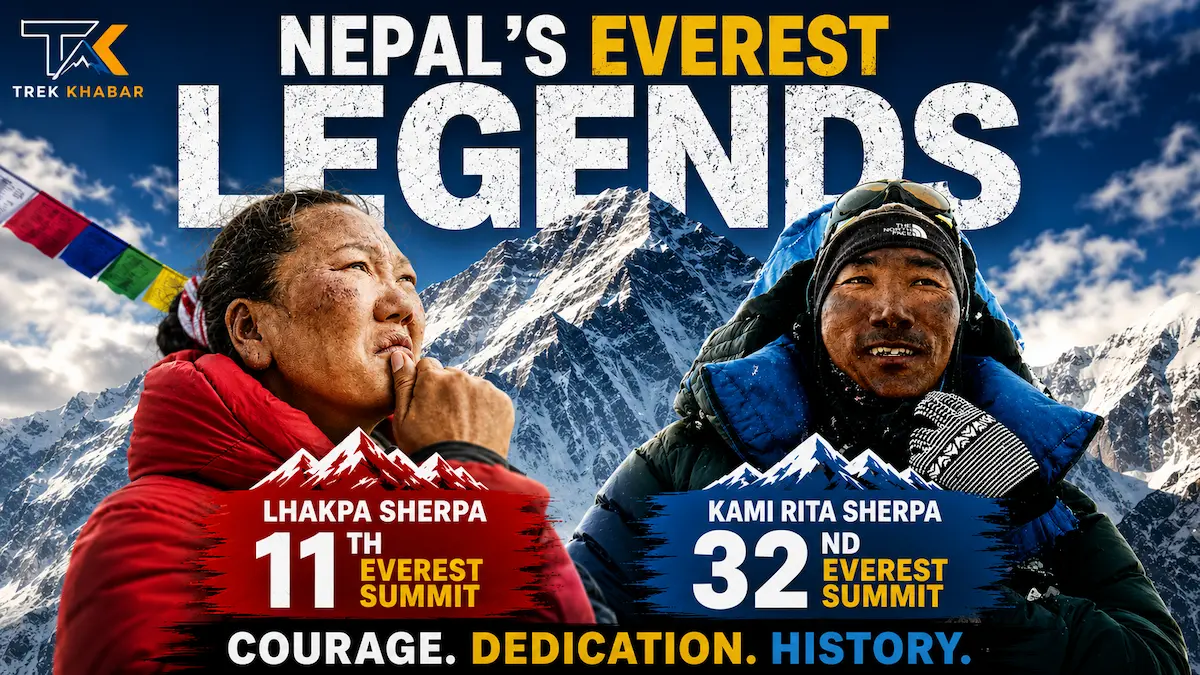
New Everest Records, 32th Time Ascended the world highest peak while men of similar age are suffering from knee and Joint Problem. Another Ascendent reached the top from Grocery aisle as observed by Trekkhabar. At 26,000 feet, on the flat grey wasteland of the South Col, there is no ceremony. No camera crew. No trending hashtag visible from inside a down suit rated to minus 40. There is wind — the kind that doesn’t howl so much as press, relentlessly, against every layer you own. There is the weight of the oxygen mask. The particular exhaustion that comes not from one hard day but from weeks of accumulated altitude, thin air, and the slow erosion of sleep.
On May 17, 2026, while BBC and CNN ran breaking news alerts and social media filled with superlatives, two climbers from the Khumbu region of Nepal were doing something far quieter. They were putting one crampon in front of the other, in the dark, at 8,000 meters, the way they have done many times before.
Kami Rita Sherpa reached the summit of Everest for the 32nd time. Lhakpa Sherpa reached it for the 11th. The world called it historic. For them, it was also just the mountain. The same mountain. Again.
The Office in the Sky
Kami Rita Sherpa is 56 years old Everest Climber.
Let that sit for a moment — not as a feel-good statistic but as a physical reality. At 56, the body’s capacity to process oxygen at extreme altitude is measurably diminished. Recovery is slower. Joints that absorbed the punishment of the Khumbu Icefall at 35 carry the memory of every crossing. The ladders over the crevasses, the fixed rope sections above Camp 3, where the mountain tilts past 45 degrees — none of it gets easier with repetition. Familiarity is not the same as comfort. He was born in Thame, a small village in the Solukhumbu district sitting at around 3,800 metres. Altitude is not something he conquered. It is simply where he is from.
Kami Rita has spoken in interviews with a matter-of-factness that tends to disarm people expecting something more dramatic. He climbs, he has said in various forms over the years, so that his children have options he did not. So they can study. So they do not have to carry other people’s loads up a mountain to survive. It is not self-pity — it is the clear-eyed accounting of a man who knows exactly what the work costs and has decided the cost is worth it.
His 32nd summit is not really about the number, though the number is staggering. It is about what the number represents: 32 seasons of preparation. 32 times navigating the Icefall, which kills experienced climbers without warning, where seracs the size of apartment buildings shift and collapse on their own schedule. 32 summit pushes through the Death Zone, where the human body is, by any physiological measure, dying.
There is a particular kind of mastery that looks effortless from the outside precisely because it is built on so much invisible labour. Kami Rita carries fixed ropes up the Lhotse Face so that paying clients — many of whom are attempting Everest for the first and only time — can clip in and feel safe. He manages weather windows, paces acclimatization rotations, makes judgment calls in conditions where a wrong decision is permanent.
He does not talk about this as heroism. It is, for him, professional competence. The quiet confidence of someone who has learned a craft so thoroughly that the craft becomes invisible.
At 56, with 32 summits, Kami Rita Sherpa is the most experienced high-altitude climber in the history of mountaineering. He celebrated, by most accounts, with tea.
From the Grocery Aisle to the Summit
Lhakpa Sherpa has, at various points in her life, worked supermarket shifts in Hartford, Connecticut. She has navigated American immigration paperwork, raised children largely on her own after a difficult marriage, and balanced the logistics of a working-class life in a country that had no particular framework for a woman who also happened to be the most accomplished female high-altitude climber on Earth.
She is 52. This was her 11th summit of Everest.
The gap between those two realities — the supermarket aisle and the South Col — is not a metaphor. It is her actual life. She moves between these worlds with a pragmatism that says more about her character than any summit statistic could.
Lhakpa grew up in Chialsa, in the Solukhumbu region, one of eleven children. She walked for days to reach school. She summited Everest for the first time in 2000, becoming the first Nepali woman to reach the top and descend safely — a detail that often gets dropped from the headline but matters enormously. Many climbers reach the summit. Getting back down is the other half of the problem.
The documentary Mountain Queen, which brought her story to a broader international audience, captured something that feels true to people who have spent time around the Khumbu community: the absence of performance. Lhakpa does not summit Everest to prove a point. She does it because Everest is, in some foundational way, part of who she is. The mountain is not a backdrop for her personal growth narrative. It is a place she knows.
What makes her 11th summit in 2026 particularly striking is the context of where she returns from each time. Not a training facility. Not a sponsored athlete programme. The ordinary friction of a life — bills, children, work schedules — and then, when the season comes, the mountain.
In a climbing world that still skews heavily male, still tends to frame female achievement as exceptional rather than expected, Lhakpa has simply continued. No fanfare between summits. No sabbatical to prepare. Just the work, and then the mountain, and then back to the work.
| Name | Summit Number | Age | Key Highlight |
|---|---|---|---|
| Kami Rita Sherpa | 32nd | 56 | Most Everest summits in history by any climber |
| Lhakpa Sherpa | 11th | 52 | Most Everest summits by any woman in history |
What the Summit Means in Solukhumbu
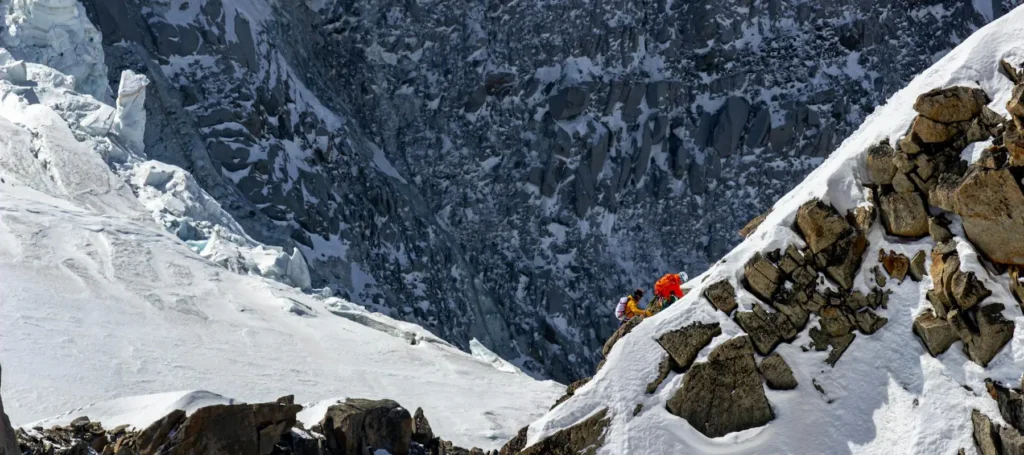
Western mountaineering culture has long treated Everest as a destination — something to be reached, checked off, and photographed. The economy that grew up around this culture transformed the Khumbu region in complicated ways, bringing income and infrastructure alongside risk and inequality.
What sometimes gets lost in that framing is that for Sherpa families, Sagarmatha — the Nepali and Tibetan name for Everest, meaning roughly “forehead of the sky” — is not a destination. It is a presence. A geographic and spiritual anchor to a landscape that has shaped the Sherpa people for generations. The mountain is approached with offerings, with prayer flags, with a relationship that predates the arrival of foreign expeditions by centuries.
When Kami Rita and Lhakpa summit, they are not conquering anything. They are moving through a place they have always known, doing work they have spent their lives learning, carrying the weight of community expectations and family history alongside the technical gear.
The records they hold belong to them. But they also belong, in some sense, to Thame, to Chialsa, to every Sherpa family that has sent someone up the mountain and waited, quietly, for them to come back down.
The Mountain Will Still Be There
Neither Kami Rita nor Lhakpa has announced retirement. Neither, as far as anyone can tell, spends much time contemplating their place in the record books. There is next season to think about. There are logistics, clients, family.
The mountain will still be there. It always is.
If this piece has left you thinking about the Sherpa community, the culture of the Khumbu region, or what it actually looks like to travel through this part of Nepal with genuine respect for the people who call it home — we’d encourage you to keep reading. Our Nepal travel guides are written with that same intention.
And if you have thoughts, memories of the region, or simply want to mark the significance of May 17, 2026, the comments are open. We read them all.
