


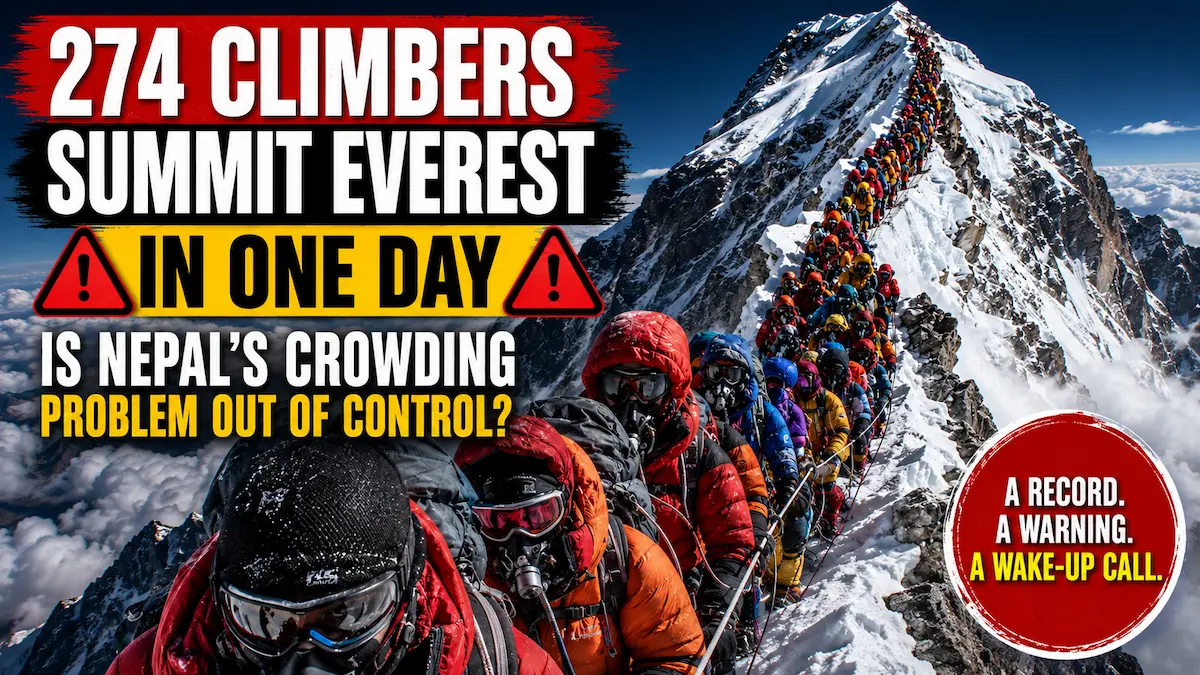
On May 20, 2026, 274 people stood on top of the world in a single day. That’s a record. It’s also a warning.
On May 20, 2026, 274 people stood on top of the world in a single day. That’s a record. It’s also a warning.
The Day the Mountain Got Too Crowded
Imagine standing in a line — except the line is at 8,800 meters, the temperature is -30°C, your oxygen tank is slowly emptying, and you can’t go anywhere.
That was the reality for hundreds of climbers on Everest this spring.
For weeks, powerful jet stream winds locked everyone in their camps. When a rare weather window finally cracked open on May 20, 2026, hundreds of climbers surged upward at the same time. The result? A record-shattering 274 successful summits in a single day — and terrifying queues snaking up the Hillary Step, deep inside the Death Zone.
It was historic. It was dangerous. And it’s sparked a debate Nepal can no longer ignore.
What Actually Happened on May 20?
The spring 2026 season saw Nepal issue 494 Everest climbing permits, generating over $7.2 million USD in direct royalty fees. When that one good weather day arrived, nearly half of those permit holders pushed for the summit simultaneously.
Among the highlights:
- 🇳🇵 Kami Rita Sherpa set a new world record — his 32nd summit of Everest
- 🇦🇺 Bianca Jane Adler, 18, became the youngest Australian to summit Everest
- 🇪🇨 Marcelo Segovia of Ecuador summited without supplementary oxygen — a rare elite feat
But behind the celebrations were images that shocked the climbing world: a single rope. Hundreds of people clipped to it. Hours of waiting. No room to move.
Why Is Crowding So Dangerous Up There?
Most people don’t realize how fragile the margin for survival is above 8,000 meters — what climbers call the Death Zone. Every minute you stand still costs you.
Here’s what happens when a queue forms up there:
1. Your oxygen runs out faster than planned. Bottled O₂ is calculated based on hours of movement. Stand still for two hours? You’ve now burned through reserves meant for the descent. This is life or death.
2. Frostbite sets in quickly. When you stop moving, blood circulation slows. At -30°C or colder, fingers and toes can suffer permanent frostbite damage in minutes.
3. Your brain stops working properly. Altitude impairs judgment. The longer you stay in the Death Zone, the worse decisions you make — exactly when you need to be sharpest for the dangerous descent.
These aren’t hypothetical risks. They have killed climbers before. And they will again, if nothing changes.
“The Government Needs to Control It” — Kami Rita Sherpa
When the world’s most experienced Everest climber speaks, people should listen.
After his record-breaking 32nd summit, Kami Rita Sherpa returned to Kathmandu to a hero’s welcome. Then he immediately issued a serious warning:
“This expedition was a bit crowded; the number of climbers was high in comparison to last year. The government needs to control it. It’s not about limiting the number of climbers on a day-by-day basis. The government should focus more on the quality of the climbers — more qualified, highly experienced climbers should be allowed to go. The numbers should be limited; there should be a cap.”
That’s not a celebrity opinion. That’s the world’s most qualified Everest expert saying the system is broken.
So, Why Doesn’t Nepal Just Cap the Permits?
Here’s the uncomfortable truth: money.
Nepal raised the foreign climber permit fee to $15,000 USD this season — up from $11,000. And yet, demand hit record highs anyway. The 494 Everest permits alone brought in $7.2 million. Total royalties across all Himalayan peaks reached $8.3 million from 1,134 permits across 55 countries.
| Peak | Permits | Revenue (USD) | Top Countries |
|---|---|---|---|
| Mount Everest | 494 | ~$7.2 Million | China (109), USA (76), India (61) |
| All Peaks | 1,134 | ~$8.3 Million | 55 Countries |
Tourism isn’t just a nice-to-have for Nepal — it’s a lifeline. Thousands of Sherpas, guides, porters, and lodge owners depend on this income. The government’s Tourism Decade Campaign is actively trying to grow arrivals to 3.5 million tourists per year by 2032.
Capping permits means capping income. That’s a hard political decision.
But here’s the counter-argument: one high-profile mass-casualty event on an overcrowded mountain could destroy Nepal’s mountaineering reputation overnight. The economic risk of not acting may be far greater.
The Real Question: What Counts as “Qualified”?
Kami Rita’s suggestion — filter by experience, not just ability to pay — is worth unpacking.
Right now, if you can afford $45,000–$100,000 for an expedition and pass a basic medical check, you can attempt Everest. There’s no mandatory experience requirement proving you’ve climbed at high altitude before.
Some experts argue this is the core problem. An inexperienced climber who panics in a queue, moves too slowly, or runs out of oxygen doesn’t just risk their own life — they block the rope for everyone behind them.
A tiered experience system — similar to how commercial aviation licenses work — could change the math entirely.
What Needs to Happen Next
Nepal’s tourism leadership is facing some tough choices as the monsoon approaches and the Khumbu Icefall ladders come down for the season. Here’s what experts are calling for:
✅ A hard permit cap — Limit total permits per season, regardless of demand
✅ Experience prerequisites — Require documented high-altitude climbs (e.g., 7,000m+) before issuing an Everest permit
✅ Staggered summit windows — Coordinate expedition departure times to reduce single-day surges
✅ Better weather forecasting integration — Work with agencies to spread climbers across multiple windows
✅ Stronger penalties for unsafe operators — Hold expedition companies accountable for underprepared clients
None of these is easy. All of them are necessary.
The Bottom Line
May 20, 2026 was a remarkable day on the mountain. Records were broken. Dreams were fulfilled. But the photograph the world will remember isn’t of a smiling climber on the summit — it’s of a hundred people jammed onto a single rope, gasping for air, waiting their turn to survive.
Everest isn’t just a mountain anymore. It’s a policy problem.
Nepal has the data, the expert voices, and the global attention to act. The only question is whether they will — before the mountain forces the decision for them.
